Written by Ethan Walker · Reviewed against our Editorial Guidelines · Updated August 29, 2026
Do Raised Dog Bowls Cause Bloat?
Raised (elevated) dog bowls don't definitely cause bloat, but the most-cited research on the question — a large Purdue University study published in 2000 — found an association between raised feeders and higher GDV (bloat) rates in large and giant deep-chested breeds, which is why many vets now recommend caution rather than automatic elevation. If you've been shopping for a bowl stand and stumbled on forum threads arguing both sides, you're not imagining the confusion — this is a genuinely debated topic, even among vets.
This guide lays out what the actual evidence says, why the raised-bowl idea became popular in the first place, which dogs it's worth being cautious for, and what to do if you're not sure whether to elevate your dog's bowl.
⚠️ This article is general information, not veterinary advice. Bloat (GDV) is a life-threatening emergency. If you think your dog may be bloating, contact your vet immediately — see our full guide on dog bloat symptoms and prevention for the warning signs.
Why did people start using raised bowls in the first place?
For years, raised (elevated) dog bowls were marketed on the idea that they're easier on the neck and joints, especially for large breeds and older dogs who have to bend a long way down to a floor bowl. That reasoning still holds up reasonably well for comfort — it's the bloat-prevention claim that turned out to be far shakier than the marketing suggested.
The original comfort argument sounds intuitive: a tall dog bending less to eat seems like it should be more comfortable. Whether that translates into a real, measurable joint benefit for most healthy adult dogs is less clear than the marketing implies — but the comfort angle isn't what raises safety questions. The bloat angle is.
What does the research actually say about raised bowls and bloat?
The most-cited study here is a large-scale epidemiological study from Purdue University (Glickman et al.) that looked at risk factors for GDV in large and giant breed dogs. It found that dogs fed from a raised bowl had a higher incidence of GDV than dogs fed from floor-level bowls, particularly in deep-chested breeds already known to be at elevated risk.
A few things are important to be honest about here:
- This is an association, not a proven cause-and-effect. The study didn't show raised bowls directly cause bloat — it showed dogs that used them had bloat more often, which could involve other factors too.
- The effect was studied specifically in large and giant breeds already prone to GDV — not necessarily in small or medium dogs.
- Other, smaller studies and later analyses have produced mixed results, and the topic hasn't been fully settled with newer, larger research.
- Some vets still recommend raised bowls for arthritis or neck pain in specific dogs, judging that comfort benefit worth discussing case by case — this is exactly the kind of decision that should go through your vet, not a blog post.
The honest summary: for large, deep-chested breeds already at higher bloat risk, the cautious default many vets now suggest is a floor-level bowl, not an elevated one — but this is an evolving, debated area, and your vet's take on your specific dog matters more than any general rule.
Which dogs should be more cautious about raised bowls?
Based on the available research, extra caution is most relevant for:
- Large and giant deep-chested breeds — Great Danes, German Shepherds, Standard Poodles, Boxers, Weimaraners, Setters, and similar breeds already flagged as higher bloat risk. See our full dog bloat symptoms, causes, and prevention guide for the complete risk-factor list.
- Dogs with a family history of bloat — a first-degree relative with GDV raises a dog's individual risk regardless of bowl height.
- Fast eaters within those higher-risk breeds — since gulping air is a separate, additive risk factor, a fast-eating Great Dane on a raised bowl is stacking two risk factors rather than one. See our best slow feeder for Great Danes for a floor-level fix that avoids the elevation question entirely.
For small and medium breeds not typically prone to bloat, the raised-bowl-and-GDV link found in the research is far less relevant, since the original study's association was concentrated in large, deep-chested dogs. Comfort (joint stiffness, arthritis, older dogs) is a more reasonable basis for the decision in these dogs — again, best discussed with your vet.
If you're not sure, what should you do?
Here's a practical, non-alarmist way to think about it:
- If your dog is a small or medium breed with no bloat history — the raised-bowl-bloat concern is less directly relevant to them, based on what the research actually studied. A raised bowl for comfort is a reasonable, low-stakes choice if your vet agrees it fits your dog.
- If your dog is a large or giant deep-chested breed — talk to your vet before choosing a raised feeder. Many vets, given the available (if imperfect) evidence, will suggest a floor-level bowl as the more cautious default for these breeds.
- If your dog already has a raised stand and no history of bloat symptoms — this isn't necessarily cause for alarm; it means it's worth a conversation at your next vet visit rather than an emergency change. Sudden changes to routine can also cause their own stress, so don't feel you need to panic-swap overnight.
- Either way, tackle a risk factor you can easily control: eating speed. Gulping air while eating fast is a widely cited contributor to bloat risk, independent of bowl height. A slow feeder bowl that sits flat on the floor addresses this directly, without adding the debated elevation variable to the mix.
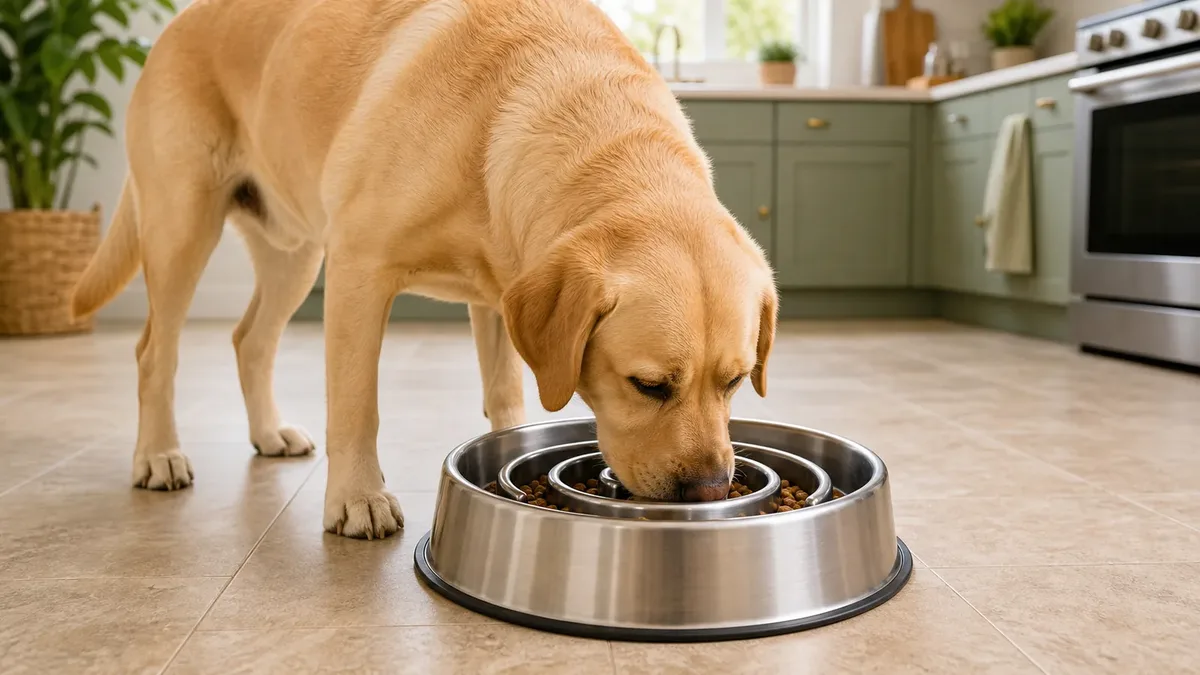
If you'd rather skip the elevation debate altogether while still slowing a fast eater, our Stainless Steel Slow Feeder Dog Bowl is designed to sit flat on the floor. It uses a raised maze pattern inside the bowl — not an elevated stand — to slow gulping, which tackles a widely cited risk factor while avoiding the more debated one.
👉 See the Stainless Steel Slow Feeder Dog Bowl →
Raised bowls aren't all bad — the comfort case
It's worth being fair to the other side of this: raised bowls remain a genuinely popular, widely-used product, and plenty of dogs use them their whole lives without incident. The comfort argument — less bending for very tall dogs or dogs with joint stiffness — is a real, separate benefit from the bloat question, and for many dogs the tradeoff is one your vet may feel comfortable with.
The point of this guide isn't "never use a raised bowl." It's that the bloat-prevention marketing claim attached to raised bowls doesn't hold up as cleanly as it's often presented, and if you have a large, deep-chested dog, that's worth knowing before you buy — and worth a specific conversation with your vet rather than a decision made from a product listing.
For a full breakdown of how bowl height affects different sizes of dog, see our elevated dog bowl height guide. And if you're weighing a raised stand against a flat slow feeder altogether, our raised bowl vs. slow feeder comparison walks through the full tradeoff.
The bottom line
Raised dog bowls aren't proven to cause bloat, but a well-known study found an association in large, deep-chested breeds — which is exactly why many vets now suggest caution for those dogs rather than assuming elevation is automatically fine. For small and medium breeds without a bloat history, the concern is less directly relevant, and comfort can reasonably guide the decision alongside your vet's input. For higher-risk breeds, a floor-level bowl is the more cautious default many vets currently favor, and slowing your dog's eating speed with a flat slow feeder addresses a widely cited risk factor you can control.
If in doubt, this is a five-minute conversation worth having at your dog's next vet visit — not a decision to make alone from a product page.
👉 See the Stainless Steel Slow Feeder Dog Bowl →
Frequently Asked Questions
Do raised dog bowls cause bloat in dogs? Not definitively — but a well-known Purdue University study found an association between raised bowls and higher GDV (bloat) rates in large and giant deep-chested breeds. It's an association, not proof of direct cause, and later research has been mixed. Many vets now suggest caution with raised bowls for higher-risk breeds specifically.
Which dogs should avoid raised bowls because of bloat risk? The concern is most relevant for large and giant deep-chested breeds already prone to bloat, such as Great Danes, German Shepherds, Standard Poodles, Boxers, and Weimaraners, especially those with a family history of GDV. Small and medium breeds weren't the focus of the research showing this association.
Is a raised bowl ever a good idea? Yes, for many dogs. Raised bowls can be more comfortable for dogs with joint stiffness, arthritis, or a very tall stature, since they reduce how far the dog bends to eat. This comfort benefit is separate from the bloat question and is worth discussing with your vet for your specific dog.
What's a safer alternative if I'm worried about bloat? A floor-level slow feeder bowl slows down fast eating — a widely cited risk factor — without introducing the more debated elevation variable. Splitting meals into smaller portions and avoiding hard exercise around mealtimes are other steps that may help reduce bloat risk.
Save this guide