Written by Ethan Walker · Reviewed against our Editorial Guidelines · Updated August 17, 2026
Raised Dog Bowl vs Slow Feeder: Do You Need Both?
A raised dog bowl and a slow feeder solve two different problems — a raised bowl addresses how far your dog bends to eat, while a slow feeder addresses how fast your dog eats — so the two aren't really rivals, and many dogs would benefit from a slow feeder specifically, whether or not they also use a raised stand. If you've been searching for "raised dog bowl vs slow feeder" hoping for a single winner, the honest answer is that it depends on which problem you actually have.
This guide breaks down what each one is designed to fix, when you need one, the other, both, or neither, and an important safety note if you're considering a raised bowl for a large breed.
Quick comparison: what each one actually solves
| Factor | 🟫 Raised Dog Bowl | 🟩 Slow Feeder Bowl |
|---|---|---|
| Main problem it solves | Posture and reach — less bending to eat | Eating speed — less gulping |
| Best for | Tall dogs, dogs with joint stiffness, seniors | Fast eaters of any size or age |
| Bloat consideration | Some evidence links it to higher risk in large, deep-chested breeds | May help reduce one contributing risk factor (swallowed air) |
| Sits on the floor? | No — elevated on a stand | Yes — flat on the floor |
| Can you use both together? | Yes — many stands accept a bowl or insert on top | Yes — pairs naturally with a stand if height is appropriate |
| Everyday cleaning | Depends on the bowl/insert used | Easy — stainless steel rinses or goes in the dishwasher |
The short version: they're not answering the same question. A raised bowl is about how your dog's body is positioned. A slow feeder is about how quickly food disappears.
What a raised dog bowl is actually for
A raised (elevated) dog bowl sits on a stand, platform, or built-in riser instead of directly on the floor. The idea is to reduce how far a dog has to bend their neck and lower their body to reach their food — which can be genuinely more comfortable for very tall dogs, dogs with joint stiffness or arthritis, and some seniors.
It does not, on its own, change how fast your dog eats. A dog that gulps its food in ten seconds will still gulp it in ten seconds from a raised bowl — the bowl is simply higher off the ground.
There's also a caveat worth knowing before you buy one: some research has linked raised bowls to a higher rate of bloat (GDV) specifically in large and giant deep-chested breeds. It's a debated, associative finding rather than settled proof, but it's relevant enough that we've dedicated a full guide to it — see do raised dog bowls cause bloat? if this applies to your dog's breed. For sizing one correctly if you do go this route, our elevated dog bowl height guide covers the right height by dog size.
What a slow feeder bowl is actually for
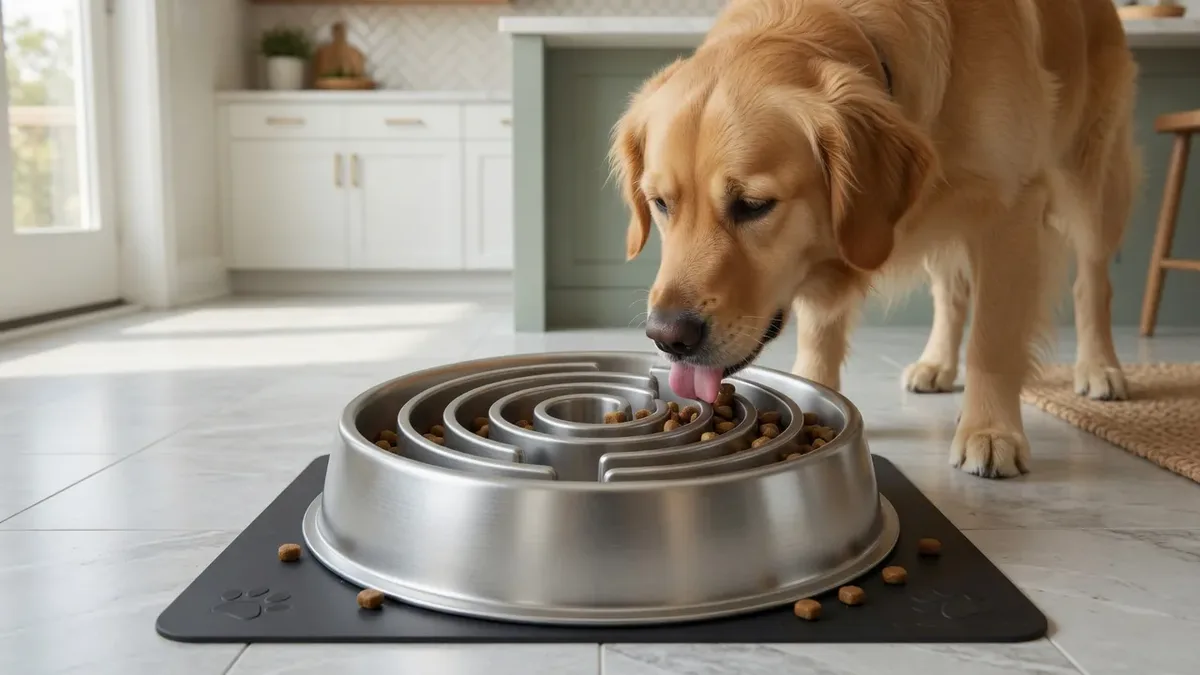
A slow feeder bowl has a raised maze or ridge pattern moulded into the base of the dish itself. Instead of one open pool of food a dog can inhale in seconds, the food sits between the ridges, forcing your dog to nudge, lick, and work each piece out — turning a 10-second gulp into a several-minute meal.
This directly targets eating speed, which matters for several real reasons:
- Less swallowed air, which is a widely cited contributor to bloat risk
- Less post-meal vomiting and regurgitation from a stomach that couldn't keep up
- Less gas and digestive discomfort
- A bit of mental engagement from working the maze, instead of a meal that's over before it started
A slow feeder sits flat on the floor by design — it doesn't touch the posture question at all. For the full case on why this matters, see are slow feeder bowls good for dogs?
Our Stainless Steel Slow Feeder Dog Bowl is built specifically for this: a non-porous, dishwasher-safe maze pattern that slows gulping at every meal, with a non-slip base that keeps it steady on the floor.
👉 See the Stainless Steel Slow Feeder Dog Bowl →
So which one does your dog actually need?
Ask yourself these two separate questions, because the answer to each is independent:
Question 1: Does my dog struggle with posture or reach? Signs include stiffness after eating, reluctance to bend down, a very tall or long-backed build, or a vet-confirmed joint condition. If yes, a raised stand may help — but check the bloat consideration first if you have a large, deep-chested breed.
Question 2: Does my dog eat too fast? Signs include finishing a meal in under a minute, vomiting shortly after eating, gulping audibly, or competing with other pets for food. If yes, a slow feeder is the more directly relevant fix — and it comes without the elevation debate, since a slow feeder sits flat on the floor.
If the answer to both is yes — a tall, stiff-jointed senior who also gulps their food — you don't have to choose. A slow feeder insert or a maze-pattern bowl can often sit on top of a raised stand, giving you both the posture benefit and the pacing benefit at once, as long as the combined height still suits your dog and (for higher-risk breeds) your vet is comfortable with the elevation.
If the answer to both is no — your dog eats calmly and has no posture issues — neither is strictly necessary, though a slow feeder still adds a little enrichment even to a calm eater.
The one scenario where the choice is more clear-cut
If your dog is a large or giant deep-chested breed (Great Dane, German Shepherd, Standard Poodle, Boxer, and similar) and you're only going to address one thing, the risk-reduction case leans toward the slow feeder first. Here's why: eating speed is a widely cited, controllable risk factor, it's addressed by a bowl that sits flat on the floor (no elevation debate involved), and it's the lower-controversy choice for exactly the breeds where the raised-bowl-bloat research raises the most questions.
That doesn't mean these breeds can never use a raised stand — plenty of vets still recommend it case by case for comfort — but if you're prioritizing, start with slowing eating speed and treat elevation as a separate conversation with your vet.
The verdict
Raised dog bowl vs. slow feeder isn't really a fair fight, because they're not competing for the same job. A raised bowl is a posture and comfort tool; a slow feeder is an eating-speed tool. Most dogs benefit more directly and more universally from slowing down their eating, which is why a slow feeder is the safer "start here" pick if you can only choose one — and it's the one every dog can use, regardless of breed or bloat-risk profile.
👉 See the Stainless Steel Slow Feeder Dog Bowl →
Frequently Asked Questions
Is a raised bowl or a slow feeder better for my dog? It depends on the problem. A raised bowl helps with posture and reach for tall or stiff-jointed dogs. A slow feeder helps with eating speed for fast eaters. They solve different problems, and many dogs can use both together.
Can I put a slow feeder bowl on a raised stand? Often yes, as long as the bowl or insert fits the stand's platform and the combined height still suits your dog. This gives you both the posture benefit and the slowed-eating benefit at once.
Which is safer for a large breed dog: raised bowl or slow feeder? A slow feeder is the lower-controversy choice for large, deep-chested breeds, since it sits flat on the floor and avoids the debated link between raised bowls and bloat risk in these breeds. A raised stand can still be appropriate for some dogs, but it's worth discussing with your vet first.
Do I need both a raised bowl and a slow feeder? Only if your dog has both issues — posture/reach difficulty and fast eating. If your dog only eats too fast, a slow feeder alone addresses that. If your dog only struggles with reach and eats calmly, a raised bowl alone may be enough.
Save this guide