Written by Ethan Walker · Reviewed against our Editorial Guidelines · Updated August 17, 2026
How High Should a Raised Dog Bowl Be?
A raised dog bowl should generally sit level with your dog's chest or just below it, so their neck stays roughly straight while eating — for most dogs that's around 4–8 inches for small breeds, 8–12 inches for medium breeds, and 12–19 inches for large and giant breeds, though it varies by individual dog. Get the height wrong and a raised bowl can end up worse than no elevation at all — too low and your dog barely benefits, too high and they're straining their neck upward instead of down.
This guide walks through how to measure the right height for your dog, height ranges by size, the signs your current setup is wrong, and one important caveat to consider before you buy at all.
Why bowl height matters
The idea behind a raised bowl is simple: reduce how far your dog has to bend down and forward to reach their food, which can ease strain on the neck, shoulders, and hips — particularly useful for older dogs, dogs with joint stiffness, and very tall breeds. But that benefit only holds up if the height actually matches your dog's build.
- Too low, and a raised stand offers barely any advantage over a floor bowl — your dog still has to bend almost as far.
- Too high, and your dog has to reach up and extend their neck backward to eat, which can be just as uncomfortable as bending down, and awkward for smaller or shorter-legged dogs in particular.
The right height is specific to your dog's body, not a single number that works for every breed.
How to measure your dog for the right bowl height
- Have your dog stand normally on a flat floor, in their relaxed everyday stance.
- Measure from the floor to the top of their front shoulders (the withers) — this is your reference point.
- Aim for a bowl height at or slightly below shoulder height, so your dog's head tilts down gently rather than straight down to the floor, and their neck stays roughly level or only slightly angled while eating.
- Watch your dog eat from the new setup. If their back arches oddly, their head tilts up noticeably, or they seem to strain, the stand is too tall — adjustable stands let you correct this without buying a new one.
If you're between two height options, most guidance leans toward choosing the slightly lower option — it's a gentler adjustment and easier for your dog to adapt to.
Raised dog bowl height by dog size
These are general starting ranges — always check against your dog's actual measured shoulder height rather than relying on breed alone, since individual dogs vary:
| Dog size | Typical shoulder height | Suggested bowl height |
|---|---|---|
| Toy / small breeds (Chihuahua, Yorkie, Dachshund) | 6–15 in | 2–5 in — many small dogs do fine with little to no elevation |
| Small-medium breeds (Beagle, French Bulldog, Corgi) | 12–16 in | 4–8 in |
| Medium breeds (Border Collie, Bulldog, Cocker Spaniel) | 16–20 in | 8–12 in |
| Large breeds (Labrador, German Shepherd, Golden Retriever) | 21–25 in | 12–16 in |
| Giant breeds (Great Dane, Mastiff, Irish Wolfhound) | 26–32+ in | 16–19+ in |
Adjustable-height stands are genuinely useful here, since they let you fine-tune as a puppy grows or if you're not sure between two settings — a fixed-height stand locks you into one guess.
An important caveat before you buy a raised bowl
Height guidance aside, there's a question worth answering before you shop for a raised stand at all: is a raised bowl actually the right choice for your dog's breed and health profile?
Some research has linked raised bowls to a higher rate of bloat (GDV) specifically in large and giant deep-chested breeds — the same dogs who, height-wise, would benefit most from elevation on paper. It's a genuine tension in the topic, and it's not something a height chart alone can resolve. We cover the full picture — what the research says, which dogs it's most relevant to, and what to do if you're unsure — in our guide on whether raised dog bowls cause bloat.
If, after reading that, you decide elevation isn't the right call for your dog (or your vet advises against it for a higher-risk breed), you don't lose the ability to slow down a fast eater — that's a separate problem with its own floor-level solution.
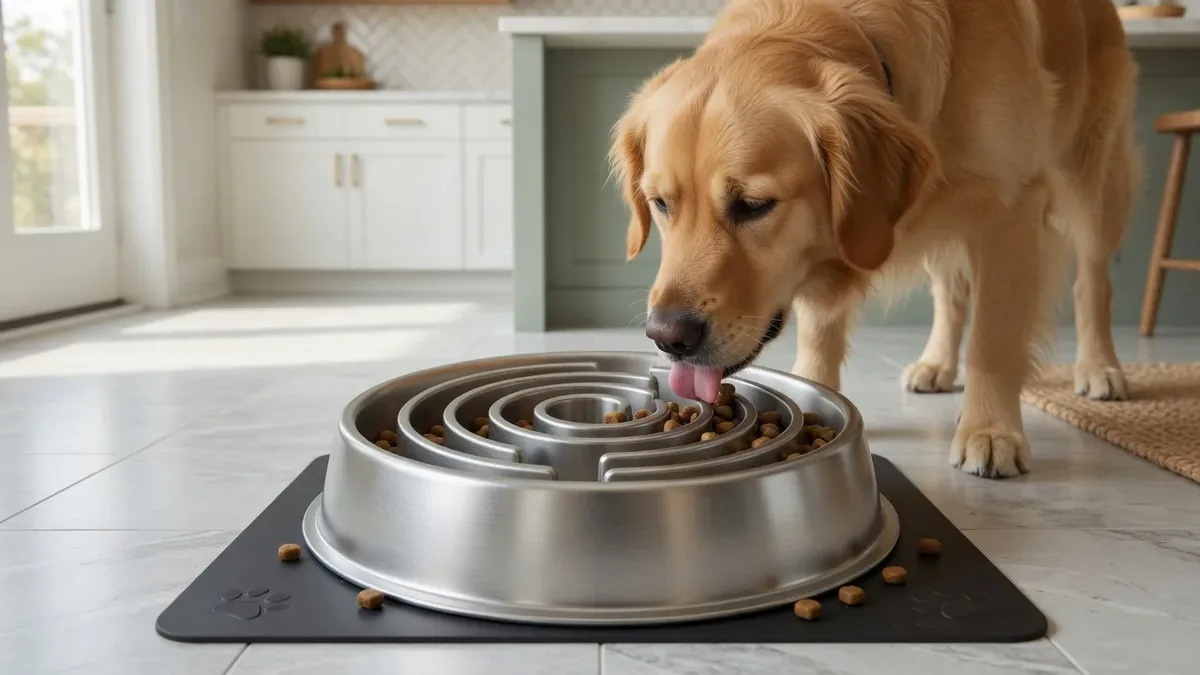
Our Stainless Steel Slow Feeder Dog Bowl sits flat on the floor and uses an internal maze pattern to pace meals, so you can address fast eating without needing to solve the height question at all. It's a straightforward option if you'd rather sidestep the raised-bowl debate entirely.
👉 See the Stainless Steel Slow Feeder Dog Bowl →
Signs your current bowl height is wrong
Watch for these while your dog eats or drinks:
- Head tilts noticeably up or back to reach the bowl — usually means it's too high
- Dog crouches, hunches, or splays their front legs to reach down — usually means it's too low, or not elevated at all when it should be
- Reluctance to approach the bowl, or eating in short bursts rather than settling in
- Visible discomfort after eating — stiffness, slow to get up, or reluctance to lower the head again for water
If you notice any of these, it's worth adjusting the height (or removing the stand altogether) rather than assuming your dog will just get used to it.
Raised bowl vs. a flat slow feeder — which problem are you solving?
It's worth being clear about what a raised bowl actually fixes, because it's easy to conflate two different goals:
- A raised bowl addresses posture and reach — how far your dog bends to eat.
- A slow feeder addresses eating speed — how fast your dog gulps down a meal.
They're not competing solutions to the same problem, and plenty of owners use a raised stand with a slow feeder insert placed on top of it. If you're trying to decide which one your dog actually needs, our raised bowl vs. slow feeder comparison breaks down exactly when each one earns its place in your kitchen.
The bottom line
The right raised dog bowl height sits at or just below your dog's shoulder height — roughly 4–8 inches for small breeds, 8–12 for medium, and 12–19+ for large and giant breeds, though always double-check against your own dog's measurements rather than breed averages alone. Before you commit to elevation at all, it's worth reading up on the raised-bowl-and-bloat debate, especially if you have a large or giant deep-chested breed — height is only half the decision.
If you decide a flat bowl is the safer or simpler choice, that doesn't mean giving up on slowing down mealtime.
👉 See the Stainless Steel Slow Feeder Dog Bowl →
Frequently Asked Questions
How high should a raised dog bowl be for a large dog? For large breeds (Labradors, German Shepherds, Golden Retrievers), aim for roughly 12–16 inches, and for giant breeds like Great Danes, 16–19 inches or more. Always check against your own dog's measured shoulder height rather than breed averages alone.
How high should a raised dog bowl be for a small dog? Many small and toy breeds do fine with 2–5 inches of elevation, or none at all, since their shorter legs and necks mean less bending distance to begin with. A too-tall stand can actually make eating harder for a small dog.
What happens if a raised bowl is too high? Your dog has to tilt their neck up and back to reach the food, which can be just as uncomfortable as bending too far down. Watch for head-tilting, hesitation, or stiffness after eating as signs the stand is too tall.
Should I get an adjustable-height raised bowl stand? It's often the safer choice, since it lets you fine-tune the height to your specific dog rather than guessing from a fixed stand, and adjust again as a puppy grows or if the first setting doesn't look right.
Save this guide