Written by Ethan Walker · Reviewed against our Editorial Guidelines · Updated August 17, 2026
How Much Should I Feed My Dog?
Most adult dogs need somewhere between ¼ cup and 4½+ cups of dry food a day, depending on size, activity level, and the food's calorie density — with the exact number set by your dog's food label and your vet, not a generic chart. Weight, age, activity level, breed, and calorie density all move that number, which is why the same "adult dog food" label can call for very different portions across brands. This guide gives you general ranges to work from and explains why the final answer should always come from your vet and your food's actual label.
Why there's no single answer to "how much should I feed my dog?"
Every dog food brand packs a different number of calories per cup or per gram, because recipes vary in fat, protein, and fillers. That means two bags of "adult dog food" can call for noticeably different portion sizes for the exact same dog. On top of that, a dog's actual calorie needs shift with:
- Weight and body condition — a lean, active dog burns more than a dog carrying extra weight.
- Age — puppies and young adult dogs generally need more calories per pound than seniors.
- Activity level — a dog on daily long walks or runs needs more fuel than a mostly indoor dog.
- Spay/neuter status — many dogs need slightly fewer calories after being spayed or neutered, since metabolism can shift.
- Health conditions — some conditions call for very specific portions, which is a conversation for your vet, not a blog post.
That's why the feeding guide on your dog's food bag is a starting point, not gospel — and your vet, who knows your dog's weight, body condition, and health history, is the best source for a precise number.
General portion ranges (as a rough starting point)
Here are the general ranges you'll typically see for healthy adult dogs on a standard diet, expressed as daily totals — with the caveat above in mind:
- Small dogs (under 20 lbs): roughly ¼ to 1 cup of dry food per day, split across meals
- Medium dogs (20–50 lbs): roughly 1 to 2¾ cups per day
- Large dogs (50–90 lbs): roughly 2¾ to 4½ cups per day
- Giant breeds (90+ lbs): often 4½ cups or more, depending heavily on the specific food
These numbers move a lot depending on calorie density, so treat them as a ballpark rather than a target. Always check the specific feeding chart printed on your dog's food and adjust based on your vet's guidance — the numbers above are meant to help you sanity-check a label, not replace it.
How to tell if the amount is right
Numbers on a bag are a guess until you check them against your actual dog. A few practical signs to watch for over a few weeks:
- Body condition — you should be able to feel (not necessarily see) your dog's ribs with light pressure, with a visible waist from above.
- Energy levels — steady energy without excessive hunger or lethargy is a good sign the amount is roughly right.
- Weight trend — regular weigh-ins (your vet can help, or a home scale for small dogs) catch slow weight gain or loss before it becomes a bigger issue.
- Stool quality — consistently very loose stools or unusually hard, small stools can sometimes point to a portion or diet issue worth mentioning to your vet.
If your dog seems consistently hungry, is losing or gaining weight unexpectedly, or you're just not confident in the number you're using, that's exactly the kind of thing to bring to your vet rather than guess your way through.
Splitting the amount across meals
Most adult dogs do well with two meals a day rather than one large meal, since it's easier on digestion and helps avoid a starving-then-stuffed cycle. Puppies typically need more frequent, smaller meals — see our puppy feeding schedule guide for a breakdown by age.
However you split the daily total, how fast your dog eats it matters almost as much as how much. A dog that inhales two cups in 20 seconds is more likely to gulp air, vomit shortly after eating, or feel unsatisfied despite getting a full portion. That's a bowl problem, not a portion problem.
Making the right amount go further
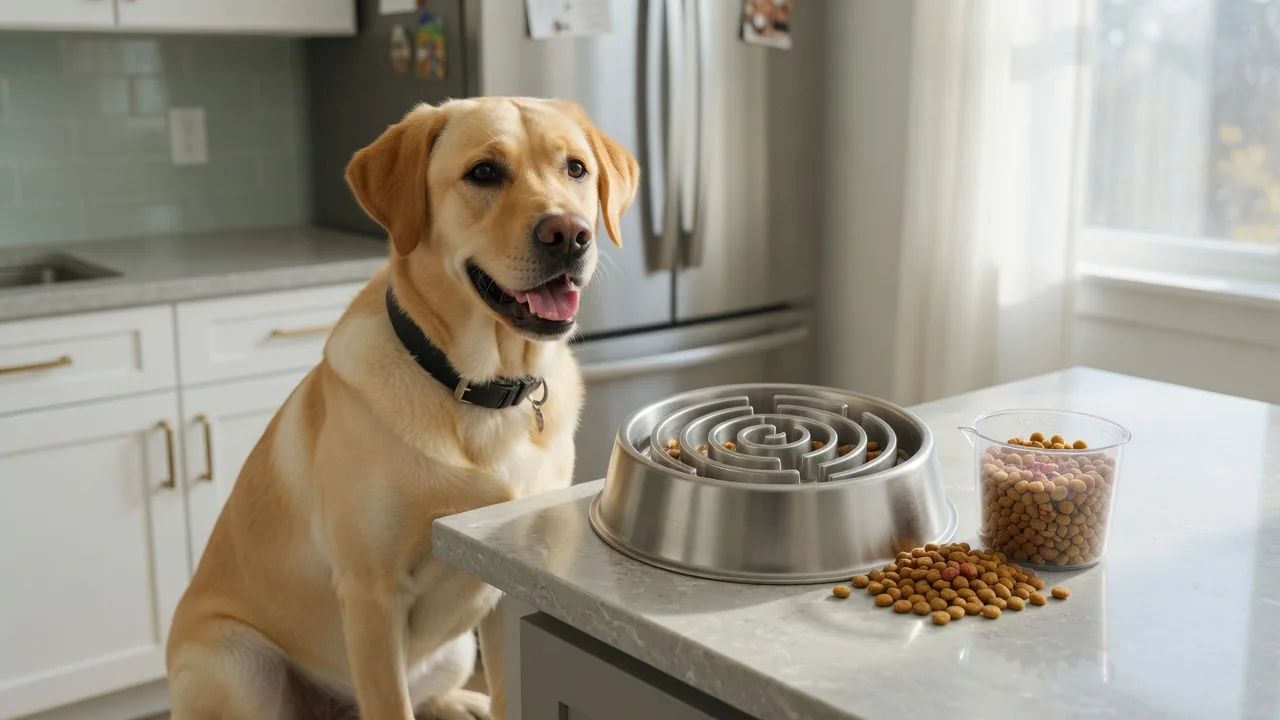
If your dog eats fast or seems to finish meals in seconds and immediately ask for more, a stainless steel slow feeder slows the meal down without changing the actual amount you feed. The raised maze pattern breaks the same portion into small pockets, so your dog spends several minutes working for it instead of gulping the whole thing in one go — often leaving them calmer and more satisfied with the identical amount of food.
Our Stainless Steel Slow Feeder Dog Bowl doesn't reduce your dog's portion — it just changes the pace, which is often what "he's always hungry" actually turns out to be.
Splitting part of a meal onto a snuffle mat is another way to stretch the same portion into a longer, more satisfying activity, since foraging for each piece takes real mental effort. We go deeper on eating speed in why does my dog eat so fast and how to stop your dog eating too fast.
When to talk to your vet
Skip the guesswork and book a check-in if:
- Your dog is noticeably over or underweight and you're not sure how to adjust
- You're feeding a puppy, senior, or a dog with a medical condition
- Your dog seems constantly hungry despite eating what the label recommends
- You're switching foods and unsure how the new calorie density compares
A quick vet visit (or even a phone call with your vet's office) can turn a vague feeding chart into an actual number tailored to your dog.
The bottom line
How much should you feed your dog? Generally somewhere between a quarter cup and several cups a day depending on size, but the real answer sits on your food's feeding label and in your vet's advice — not in a generic range. Once you've got the amount roughly right, how you serve it matters too: a slow feeder or snuffle mat can turn the same portion into a calmer, more satisfying meal.
👉 See the Stainless Steel Slow Feeder Dog Bowl →
Frequently Asked Questions
How do I know exactly how much to feed my dog? Start with the feeding chart on your dog's specific food, then confirm with your vet based on your dog's weight, age, and activity level. General ranges online are a sanity check, not a substitute for those two sources.
Is it better to feed my dog once or twice a day? Most adult dogs do well with two meals a day for steadier digestion and energy. Puppies typically need more frequent meals — see our puppy feeding schedule guide for specifics by age.
Why does my dog always seem hungry even after eating the recommended amount? It can be the portion, the food's calorie density, or simply how fast your dog eats — a dog that gulps a meal in seconds often feels less satisfied than one who eats the same amount slowly. A slow feeder bowl can help with the eating-speed side of this.
Does the amount change after spaying or neutering? Often yes — many dogs need a slightly smaller portion afterward since metabolism can shift. Ask your vet for guidance specific to your dog.