Written by Ethan Walker · Reviewed against our Editorial Guidelines · Updated September 8, 2026
Puppy Feeding Schedule: A Guide By Age
A puppy feeding schedule generally starts at 4 meals a day at 8–12 weeks old, tapers to 3 meals by 3–6 months, drops to 2 meals by 6–12 months, and settles into 1–2 adult meals a day around 12 months. This guide walks through that schedule by age, plus the habits that make mealtime easier for both of you.
Before anything else: the exact amount to feed always comes from your puppy's food label and your vet, since it depends on breed size, growth rate, and the specific food's calorie density. What we can help with is the structure — how often to feed and what a typical routine looks like.
A general puppy feeding schedule by age
Puppies need more frequent, smaller meals than adult dogs because their stomachs are small and their energy needs (relative to size) are high. As a rough framework:
- 8–12 weeks old: 4 meals a day, spaced roughly every 4–5 hours (e.g., early morning, midday, late afternoon, evening).
- 3–6 months old: 3 meals a day, spaced through the morning, afternoon, and evening.
- 6–12 months old: 2 meals a day, morning and evening, as growth slows.
- 12 months+ (or per your vet's guidance for large breeds): Most dogs transition to an adult schedule of 1–2 meals a day. Large and giant breeds often stay on puppy food longer, so ask your vet when to transition.
These ranges are a starting point, not a rulebook — some puppies do fine moving to fewer meals a little earlier or later. Your vet can confirm what's right for your specific puppy, especially for large-breed puppies where growth rate needs closer monitoring.
So if your puppy is 10 weeks old, 11 weeks old, 12 weeks old, or around 2 months old, they fall in that 8–12 week bracket — stick with 4 meals a day until they're closer to 3 months, then start easing toward 3.
Why frequent meals matter for puppies
A young puppy's blood sugar can drop faster than an adult dog's, especially in small and toy breeds. Long gaps between meals can leave a puppy lethargic, shaky, or unusually irritable — a mild version of what's sometimes called juvenile hypoglycemia. Frequent, evenly spaced meals help keep energy levels steady while your puppy's body is still developing the reserves to go longer between feedings.
Consistent timing also helps with:
- Housetraining — puppies tend to need to relieve themselves shortly after eating, so a predictable schedule makes potty breaks more predictable too.
- Digestion — regular mealtimes support a steady digestive rhythm and can reduce stomach upset.
- Behavior — a puppy who knows when food is coming is generally calmer around mealtimes than one guessing.
Building a daily routine
A simple 3-meal example for a 4-month-old puppy might look like:
- Morning (with first bathroom break of the day)
- Early afternoon (after a nap or play session)
- Evening (a few hours before bedtime, so there's time for one last potty break)
Try to keep meal times roughly consistent day to day — your puppy's digestive system and bladder both do better with a predictable rhythm than a schedule that shifts by hours each day.
Slowing down a fast-eating puppy
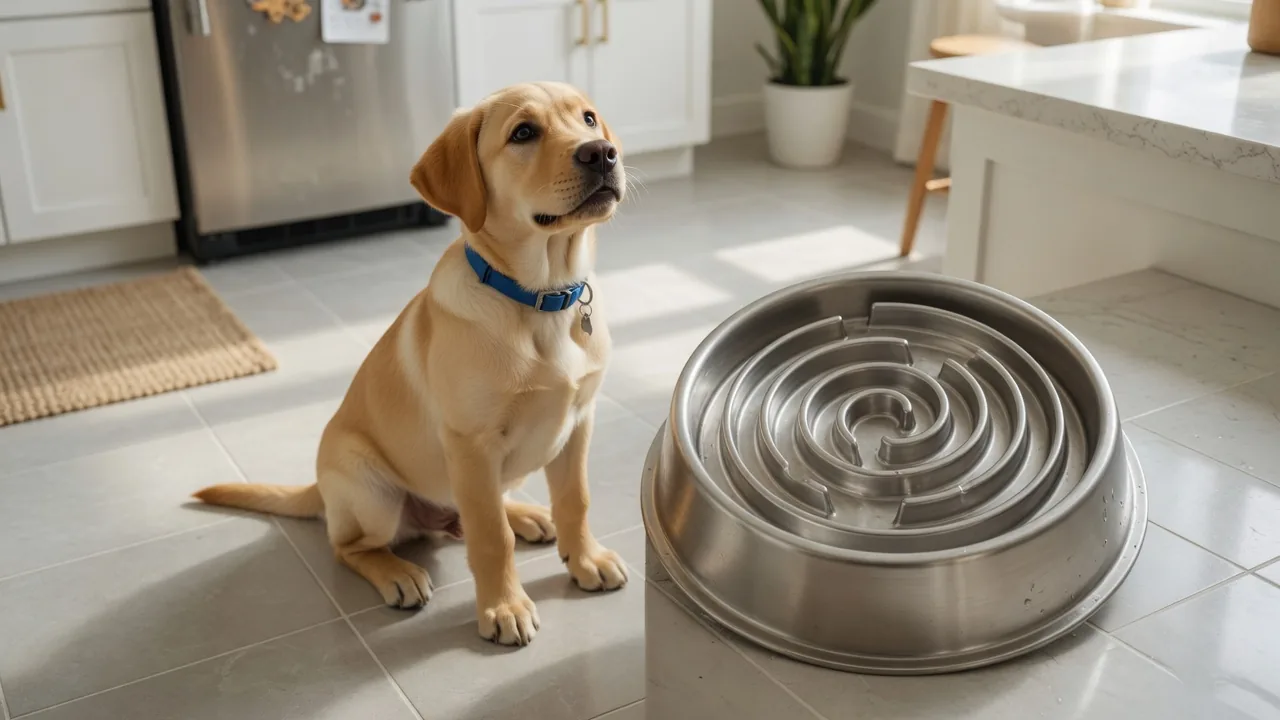
Some puppies inhale their food the moment it hits the bowl, which can lead to gulping air, gagging, or bringing the meal back up within minutes. If that sounds familiar, a stainless steel slow feeder can help — the raised maze pattern breaks the meal into small pockets so your puppy has to work for each bite instead of vacuuming the whole bowl in seconds. It's a simple swap that doesn't change how much your puppy eats, just how fast.
For puppies who also get anxious or overexcited at mealtime, spreading part of a meal across a snuffle mat can turn feeding into a calming sniff-and-forage session instead of a race. Many owners rotate between the two — a slow feeder for one meal, a snuffle mat for another — to keep things interesting. We cover this in more detail in our guide on puppy eating too fast and our roundup of the best slow feeders for puppies.
Our Stainless Steel Slow Feeder Dog Bowl comes in sizes that work well for growing puppies, with a non-slip base so an enthusiastic eater doesn't send it skating across the kitchen floor.
When to loop in your vet
A general schedule works for most healthy puppies, but check in with your vet if you notice:
- Your puppy consistently refusing meals or seeming uninterested in food
- Vomiting or diarrhea that lasts more than a day
- Unusual lethargy, shaking, or weakness between meals
- Rapid weight gain or loss that doesn't match what you'd expect for their age and breed
These can be signs of a feeding schedule that isn't working for your specific puppy, or something unrelated to feeding entirely — either way, it's worth a call rather than guessing.
The bottom line
A good puppy feeding schedule starts frequent (around 4 meals a day for very young puppies) and gradually tapers to an adult routine by around a year old. The exact portion size should always come from your puppy's food label and your vet, since it depends on breed, weight, and growth stage. What you can control is consistency — same rough times each day — and, if your puppy eats too fast, the bowl you serve it in.
👉 See the Stainless Steel Slow Feeder Dog Bowl →
Frequently Asked Questions
How many times a day should I feed my puppy? It depends on age: roughly 4 meals a day for 8–12 week old puppies, tapering to 3 meals by 3–6 months, then 2 meals from about 6 months onward. Always confirm portion size with your vet and your food's feeding label.
What time should I feed my puppy? There's no single correct time — what matters more is consistency. Spacing meals evenly through the day (for example, morning, afternoon, and evening) and keeping roughly the same times daily works well for most puppies.
When can I switch my puppy to fewer meals? Most puppies move from 4 to 3 meals around 3 months, and from 3 to 2 meals around 6 months. Large and giant breeds sometimes stay on a puppy schedule longer — ask your vet for guidance specific to your puppy's breed and growth.
My puppy eats too fast — what can I do? A slow feeder bowl with a raised maze pattern is one of the simplest fixes, since it limits how much your puppy can grab in one mouthful. See our guide on puppy eating too fast for more detail.