Written by Ethan Walker · Reviewed against our Editorial Guidelines · Updated August 17, 2026
Kibble vs Wet Food for Dogs
There's no universal winner between kibble and wet food — kibble wins on cost, convenience, and shelf life, while wet food wins on hydration (70–85% moisture vs under 12% for kibble) and appeal to picky eaters, so the right choice depends on your dog's needs, your budget, and your routine. This guide breaks down the actual differences so you can make a decision that fits your dog, not just a trend.
The core differences between kibble and wet food
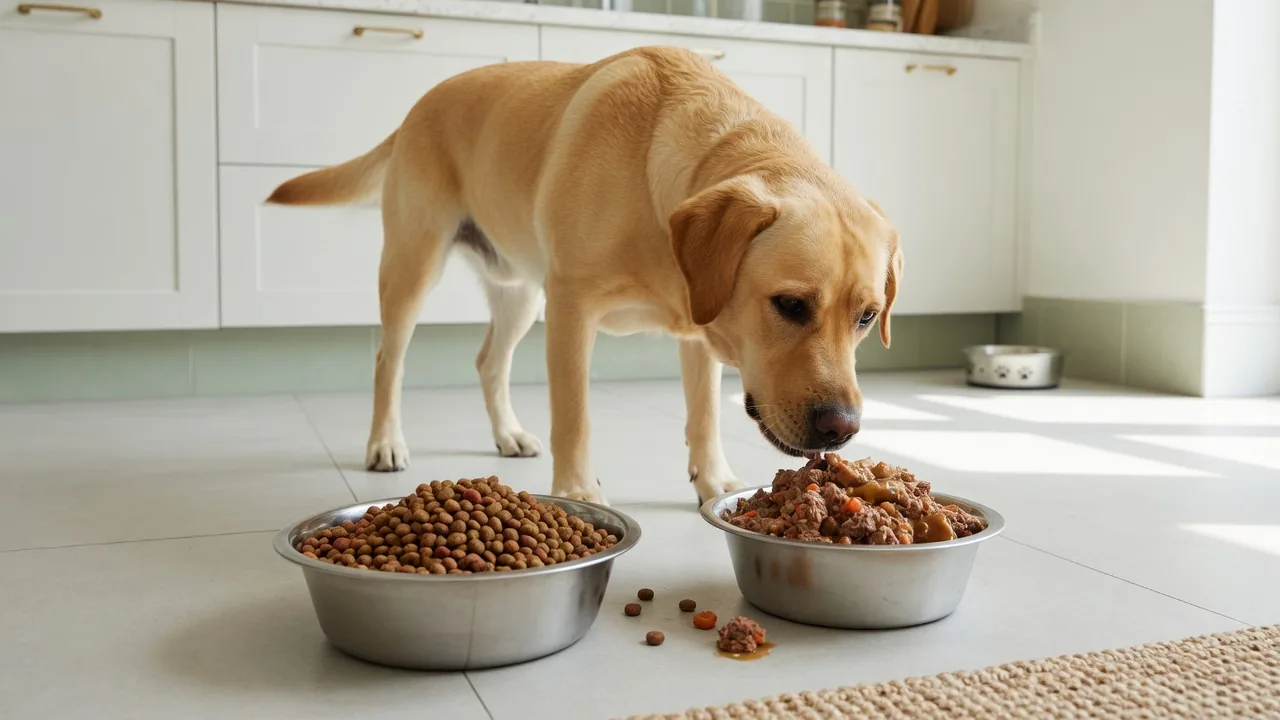
At a basic level, kibble is dry, extruded food with low moisture content (usually under 12%), while wet food is canned or pouched with much higher moisture (often 70–85%). That single difference in water content drives most of the practical differences owners notice:
- Cost per calorie — kibble is typically cheaper to feed than wet food, since you're not paying to ship and can water weight.
- Shelf life — an unopened bag of kibble lasts months at room temperature; opened wet food needs refrigeration and use within a few days.
- Calorie density — kibble packs more calories into less volume, so portions look smaller than the equivalent wet food portion.
- Palatability — many dogs find wet food more appealing due to its stronger smell and softer texture, which wins over picky eaters.
- Dental effect — kibble's dry, crunchy texture can offer some mechanical scraping action on teeth, though it's not a substitute for dental care like brushing or vet cleanings.
Neither format is inherently "better" nutrition-wise — a complete and balanced kibble and a complete and balanced wet food can both meet a dog's nutritional needs. The differences that matter most are usually practical, not nutritional.
When kibble tends to make sense
- Budget matters — kibble is generally the more economical option per calorie.
- Convenience — no refrigeration needed, easy to portion, easy to travel with.
- Free-feeding or slow feeder use — dry kibble sits out safely for longer and works well in maze-style slow feeder bowls, since the pieces don't clump the way wet food can.
- Dogs without picky-eater tendencies — if your dog already eats kibble happily, there's often no need to switch.
When wet food tends to make sense
- Hydration support — the high moisture content means wet food contributes meaningfully to daily water intake, which some owners appreciate for dogs who don't drink much on their own.
- Picky eaters — the stronger aroma and softer texture often win over dogs who turn their nose up at dry kibble.
- Dental or age-related chewing issues — dogs with missing teeth, sore gums, or other chewing difficulties (always confirm with your vet) may find wet food easier to eat.
- Weight management conversations — because wet food is less calorie-dense per volume, some owners use it as part of a vet-guided weight plan, since a full-looking bowl can have fewer calories than the kibble equivalent.
Can you mix kibble and wet food?
Yes — many owners feed a mix, sometimes called "topping" kibble with a spoonful of wet food for flavor and moisture, or alternating meals between the two. If you go this route, keep an eye on total calories so the combination doesn't add up to more than your dog needs — check the label of whichever product you introduce and adjust the other proportionally, ideally with input from your vet if you're unsure. We cover more topper ideas in our guide on dog food toppers.
The eating-speed problem with each format
Here's something the kibble-vs-wet debate usually skips: both formats can be gulped, just in different ways. Dogs on kibble often inhale handfuls at once; dogs on wet food can slurp a soft, mushy meal in seconds flat. Either way, fast eating raises the same risks — gulped air, gagging, and vomiting shortly after the meal.
For kibble, a stainless steel slow feeder is a straightforward fix — the maze pattern forces your dog to work pieces out one at a time rather than scooping mouthfuls. For wet food, a flatter slow feeder design or spreading a thin layer of wet food across the raised ridges slows things down, since your dog has to lick it off the pattern instead of gulping a pool of food.
Our Stainless Steel Slow Feeder Dog Bowl works well with dry kibble in particular, thanks to a deep maze that keeps pieces from just sliding around the pattern.
If your dog is on kibble and enjoys foraging, a snuffle mat is another great way to slow a meal down while adding mental stimulation — scatter the kibble across the fleece fabric and let your dog sniff each piece out. This works best with dry kibble rather than wet food, since wet food would stick to the fabric.
How to switch between kibble and wet food safely
If you decide to switch formats (or introduce a new brand of either), do it gradually over 5–7 days by mixing increasing amounts of the new food with decreasing amounts of the old. A sudden full switch is one of the most common causes of temporary stomach upset in dogs. If loose stools, vomiting, or refusal to eat last more than a day or two during a transition, check in with your vet.
The bottom line
Kibble vs wet food isn't really a contest — it's a fit question. Kibble tends to win on cost, convenience, and slow feeder compatibility; wet food tends to win on hydration and palatability for picky eaters. Many dogs do perfectly well on either, and plenty of owners mix both. Whichever you choose, keep an eye on how fast your dog eats it — that's often a bigger factor in comfort and digestion than the format itself.
👉 See the Stainless Steel Slow Feeder Dog Bowl →
Frequently Asked Questions
Is wet food or kibble better for dogs? Neither is universally better — a complete and balanced version of either can meet a dog's nutritional needs. Kibble tends to be more affordable and convenient; wet food tends to offer more hydration and appeal to picky eaters.
Can I mix kibble and wet food? Yes, many owners do. Just watch total daily calories so the combination doesn't exceed what your dog needs, and check with your vet if you're unsure how to balance the two.
Does kibble clean my dog's teeth? It can offer some mechanical scraping action, but it isn't a substitute for dental care like brushing or professional cleanings. Talk to your vet about a full dental care routine.
Which food type works better with a slow feeder bowl? Dry kibble tends to work best with maze-style slow feeders, since the pieces stay separated in the ridges. Wet food can still be used, especially spread thinly, but it behaves differently than dry kibble in a deep maze pattern.