Written by Ethan Walker · Reviewed against our Editorial Guidelines · Updated August 17, 2026
Dog Puzzle Toy Levels Explained
Dog puzzle toy difficulty levels (usually numbered 1 to 5, or labeled beginner/intermediate/advanced/expert) describe how many steps a dog has to figure out to get the treat — level 1 is often a single flip-lid, while level 4-5 puzzles require multi-step sequences like sliding, twisting, and pressing in a specific order. The trouble is, there's no single industry standard: one brand's "level 3" can be another brand's "level 1," which is exactly why so many owners end up buying a puzzle their dog either solves in ten seconds or gives up on entirely.
This guide breaks down what each general level actually asks of your dog, how to figure out where your dog should start, and the warning signs that you picked the wrong difficulty.
Why puzzle toy "levels" are confusing
Most dog puzzle toy brands label their products with a difficulty level, but there's no shared, industry-wide definition of what "level 2" or "level 4" means. A level rating from one brand might describe a single sliding drawer, while another brand's same-numbered level might involve three separate compartments that each need a different motion to open.
That means you can't fully trust the number alone — you need to understand what kind of mechanism sits behind it. Below is a general framework, based on the common patterns across most puzzle toy lines, that holds up reasonably well regardless of brand.
The general difficulty levels, explained
Level 1 (Beginner): single, obvious action
The treat is visible or nearly visible, and one simple motion reveals it — lifting a flap, nudging a lid off, or knocking over a cup. There's little to figure out; it's more about teaching the dog that this object holds food than genuine problem-solving.
Good for: puppies, dogs brand new to puzzle toys, or anxious dogs who need an easy early win to build confidence.
Level 2 (Easy-Intermediate): one hidden step, still single-motion
The treat is hidden from view but still accessed with a single type of motion — sliding a cover, spinning a wheel, or pulling a lever. The dog has to search a bit, but the physical action required doesn't change once they find the pocket.
Good for: most adult dogs after a level 1 or two, and dogs who've shown they solve puzzles quickly without frustration.
Level 3 (Intermediate): multiple compartments, same general motion
Several compartments hide treats, and the dog has to repeat the same action (sliding, flipping) across each one. This adds persistence and memory — did I already check this spot? — on top of the basic motion.
Good for: dogs who breeze through level 2 without much effort, or food-motivated dogs who enjoy working for every last piece.
Level 4 (Advanced): sequential, multi-step actions
The dog has to perform steps in a specific order — for example, sliding one panel to unlock a second panel, which then needs to be twisted or lifted. This is genuine problem-solving: cause and effect, not just search-and-repeat.
Good for: experienced puzzle-toy dogs, working breeds, and dogs that seem bored by anything with a single obvious motion.
Level 5 (Expert): compound, varied mechanisms
Multiple different mechanism types combined — sliding, twisting, pressing, and lifting all on the same toy, sometimes across several rounds before all the food is released. These are built for dogs that have "graduated" through the easier tiers and need ongoing novelty to stay engaged.
Good for: high-drive, food-motivated dogs who've mastered lower levels and get bored quickly; not a starting point for any dog new to puzzle toys.
How to figure out your dog's actual starting level
Don't assume a smart breed automatically means a high starting level — motivation and puzzle experience matter as much as intelligence. A quick way to gauge it:
- Start with a level 1 or 2, regardless of breed. This isn't about testing intelligence; it's about testing whether your dog understands the "this object = food" concept at all.
- Watch how quickly and calmly they solve it. Solved in under a minute with visible interest (not just walking away)? Try a step up next time.
- Watch for frustration signs, not just speed — pawing aggressively, whining, giving up and walking away, or losing interest fast. These suggest you're a level too high, not too low.
- Increase gradually. Jumping from level 1 straight to level 4 is a common mistake that leads to a bored, frustrated dog who then avoids the toy altogether.
Signs you picked the wrong difficulty
Too easy:
- Solved instantly with little interest afterward
- Dog seems to lose interest in the toy within a day or two
- No real "work" happening — treats fall out with barely any effort
Too hard:
- Dog gives up within a minute or two and walks away
- Frustration behaviors — barking at the toy, pawing aggressively, chewing on it destructively rather than working the mechanism
- Dog avoids the toy on future attempts, associating it with failure rather than reward
If you're seeing "too hard" signs, don't assume your dog "just isn't smart enough" — step back down a level and rebuild confidence. Puzzle-solving is a skill that develops with successful repetition, not a fixed trait.
A note on safety and supervision
Higher-level puzzle toys often have more moving parts, which means more small pieces that can be chewed off or swallowed if a dog gets frustrated and starts biting the toy instead of solving it. Supervise any puzzle toy, especially higher levels, and remove it if you notice chewing damage rather than intended manipulation. Puzzle-toy treats should also count toward your dog's daily food total, since it's easy to lose track when treats are doled out a piece at a time.
If your dog doesn't take to mechanism-style puzzles at all
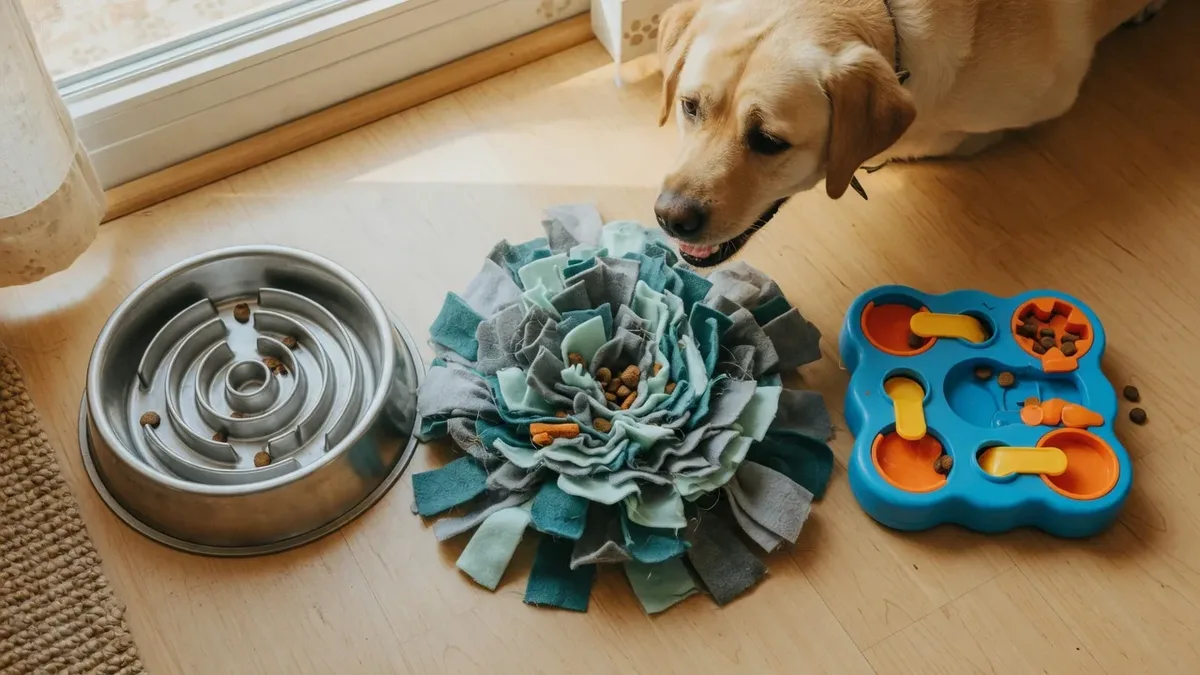
Not every dog enjoys the sliding-lid, spinning-compartment style of puzzle toy — some dogs are far more motivated by scent than by manipulating objects, no matter what "level" you try. If your dog seems more interested in sniffing out food than figuring out a mechanism, a snuffle mat may be a better fit altogether — it skips the mechanism and difficulty-level guesswork entirely, since foraging by scent is instinctive rather than a skill your dog has to learn. Our snuffle mat vs. puzzle feeder comparison walks through how to tell which style suits your dog. For the full category overview of feeders that make your dog work for food, see our dog puzzle feeder guide.
👉 See the Snuffle Mat for Dogs →
The bottom line
Dog puzzle toy levels are a useful rough guide, but the number itself isn't standardized across brands — what matters more is understanding the type of challenge (single motion, hidden search, sequential steps, or compound mechanisms) behind the label. Start low regardless of how smart your dog seems, watch for frustration rather than assuming failure means "too dumb," and step up gradually. If mechanism-style puzzles just aren't clicking for your dog, scent-based enrichment like a snuffle mat sidesteps the whole levels question.
👉 See the Snuffle Mat for Dogs →
Frequently Asked Questions
What does level 1 mean on a dog puzzle toy? Level 1 usually means a single, obvious action reveals the treat — lifting a flap or nudging off a lid. It's designed to teach a dog that the object holds food, not to test real problem-solving.
What's the hardest dog puzzle toy level? Level 4-5 (advanced/expert) puzzles typically require multiple different actions in a specific sequence, such as sliding one panel to unlock another that then needs twisting or lifting. These suit experienced, highly food-motivated dogs.
How do I know what puzzle level to start my dog at? Start at level 1 or 2 regardless of breed or perceived intelligence, then watch how your dog responds. Quick, calm solving with interest means you can try a step up; frustration or giving up means step back down.
What if my dog won't engage with any puzzle toy? Some dogs are more motivated by scent than by manipulating objects. A snuffle mat, which uses foraging instinct instead of a mechanism, is often a better fit for these dogs and has no difficulty level to figure out.
Save this guide