Written by Ethan Walker · Reviewed against our Editorial Guidelines · Updated August 17, 2026
Snuffle Mat vs Puzzle Feeder: Which Is Right for Your Dog?
A snuffle mat and a puzzle feeder both slow eating and add enrichment, but they engage your dog differently — a snuffle mat taps into scent-based foraging, while a puzzle feeder (a sliding-lid or spinning-compartment toy) taps into paw dexterity and problem-solving, so the better pick depends on what kind of "work" your dog enjoys, not which one is objectively better. If your dog is more nose than paws, or more paws than nose, that difference matters more than most buying guides let on.
This guide compares how each one works, which dogs take to which format, the practical tradeoffs (cleaning, durability, supervision), and when it makes sense to use both.
Snuffle mat vs puzzle feeder: quick comparison
| Factor | 🟦 Snuffle Mat | 🟨 Puzzle Feeder (toy) |
|---|---|---|
| Main skill used | Scent, sniffing, foraging | Paws, nose-nudging, problem-solving |
| Best for | Any dog with a nose — most dogs take to it instantly | Dogs that enjoy manipulating objects, sliding parts, flipping lids |
| Learning curve | Usually none — instinctive | Some dogs need a few tries to figure out the mechanism |
| Best food type | Dry kibble and treats | Small treats or part of a meal |
| Cleaning | Machine-washable fabric | Wipe down; harder to clean interior mechanisms |
| Durability with chewers | Can be chewed/pulled if unsupervised | Plastic/wood parts can be chewed or cracked |
| Daily feeding use | Workable for a full meal | Usually better as a sometimes-activity, not every meal |
| Supervision needed | Light | More — moving parts and small pieces |
Neither format is "better" in the abstract — it comes down to which kind of mental work your dog actually enjoys.
What a snuffle mat does best
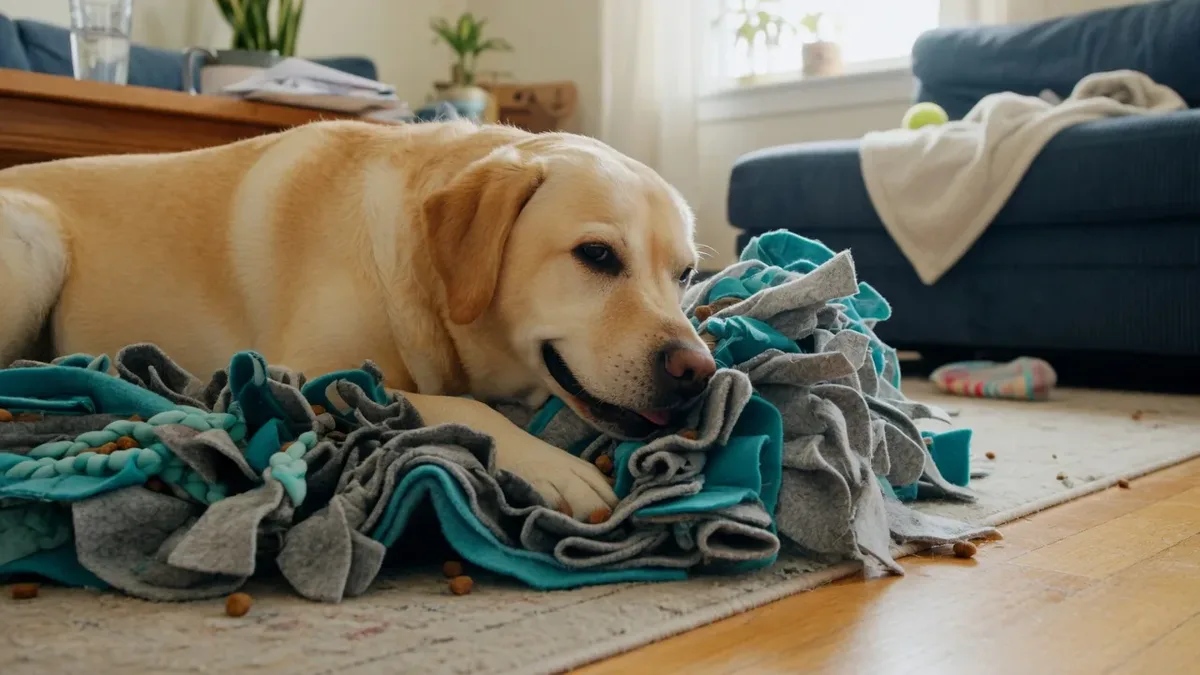
A snuffle mat is a fabric mat densely packed with fleece strips that hide kibble or treats. Your dog has to sniff, nose, and forage each piece out from between the folds — no moving parts, no mechanism to figure out, just scent work.
This makes it a genuinely low-barrier enrichment tool: almost every dog takes to it immediately, because sniffing is instinctive rather than a skill they need to learn. It's also one of the most calming activities you can give a dog — scent work is known to be mentally tiring in a settling, not amping-up, way, which is part of why it's a favorite for anxious or bored dogs.
Best for: everyday enrichment, bored or anxious dogs, rainy-day mental exercise, and any dog you want to slow down without introducing a mechanism they need to learn.
Our Snuffle Mat for Dogs is machine-washable and folds flat for storage — no small parts to lose or chew through, just fleece and a non-slip base.
👉 See the Snuffle Mat for Dogs →
What a puzzle feeder toy does best
A puzzle feeder (in the "toy" sense — sliding covers, spinning compartments, lift-flaps) asks your dog to manipulate an object with their paws or nose to release hidden treats. Difficulty ranges from beginner (nudge a lid open) to advanced (multi-step sequences that require remembering what worked last time).
This format rewards a different kind of dog: one that enjoys figuring something out, not just following a scent trail. Dogs that get frustrated by "no obvious next step" enrichment often do better here, since a puzzle toy usually has a visible, learnable mechanism rather than an open-ended search.
The tradeoffs are real, though: puzzle toys are usually better suited to treats or part of a meal, not a full daily feed, they need more supervision (some dogs chew rather than solve), and hard plastic or wood parts are harder to clean thoroughly than washable fabric. For the full breakdown of puzzle-feeder types and where they fit alongside our products, see our dog puzzle feeder guide.
Which dogs take to which format?
- Choose a snuffle mat if your dog is scent-driven (most dogs, but especially scent-hound breeds like Beagles and Bloodhounds), needs calming rather than amping up, or you want a zero-learning-curve tool that works from day one.
- Choose a puzzle feeder toy if your dog enjoys manipulating objects, gets bored of "just sniffing," and you're comfortable supervising a treat-based activity rather than a full meal.
- Choose both if you want variety — a snuffle mat for daily meals or calm-down sessions, a puzzle toy for occasional "figure this out" challenges when you have time to supervise.
If you're not sure which your dog is, a useful test: hide a treat under a towel (scent-based) versus inside a cardboard box with a flap (manipulation-based) and see which one your dog goes for first and enjoys more. That preference usually holds up with the real product.
Cleaning and everyday practicality
- Snuffle mat: machine-washable — toss it in on a gentle cycle when kibble dust builds up in the fleece. No hidden mechanisms to worry about.
- Puzzle feeder toy: typically wiped down rather than washed, since electronics or moving parts (in some models) can't go in water. Grooves and sliding compartments can trap food residue that's harder to fully clean out.
For a tool used every single day, the snuffle mat's washability is a meaningful practical edge. For an occasional treat-time activity, the puzzle toy's cleaning burden matters less since it's not in daily rotation.
Can you use a snuffle mat and a puzzle feeder together?
Yes, and many owners do — they're not competing for the same slot in your dog's routine. A common pattern:
- Snuffle mat for regular meals or daily wind-down sessions (low effort, high reliability)
- Puzzle feeder toy for weekend or "extra time" enrichment, treat-based and supervised
If your dog also tends to eat too fast at regular meals, a slow feeder bowl rounds out the toolkit — three tools, three slightly different jobs: pacing (bowl), scent enrichment (mat), and problem-solving (puzzle toy). For more ways to combine these, see our guide on dog enrichment ideas.
The verdict
Snuffle mat vs. puzzle feeder isn't about which is "better" — it's about which kind of mental work suits your dog. If your dog is a natural sniffer and you want a zero-learning-curve, washable, everyday tool, the snuffle mat wins on practicality alone. If your dog loves figuring out a mechanism and you're happy to supervise treat-based sessions, a puzzle toy adds a different kind of challenge. Plenty of dogs — and owners — end up happily using both.
👉 See the Snuffle Mat for Dogs →
Frequently Asked Questions
Is a snuffle mat or a puzzle feeder better for dogs? Neither is universally better — a snuffle mat uses scent and foraging, which almost all dogs take to instantly, while a puzzle feeder toy uses paw dexterity and problem-solving, which suits dogs that enjoy figuring out a mechanism. The right choice depends on your dog's preference.
Can a snuffle mat replace a puzzle feeder toy? For everyday enrichment and calming, yes, many owners rely on a snuffle mat alone. But a puzzle toy offers a different kind of mental challenge (object manipulation) that a snuffle mat doesn't replicate, so some dogs benefit from having both.
Is a snuffle mat good for every dog? Most dogs take to a snuffle mat quickly since sniffing is instinctive, not learned. Dogs that are more motivated by manipulating objects than sniffing may enjoy a puzzle toy more, but it's still worth trying a snuffle mat first given the low learning curve.
Do I need to supervise a snuffle mat like I would a puzzle toy? Snuffle mats generally need less supervision since there are no small hard parts to break off, though enthusiastic chewers should still be watched. Puzzle toys with moving parts typically need closer supervision.
Save this guide