Written by Ethan Walker · Reviewed against our Editorial Guidelines · Updated September 8, 2026
Dog Eats Too Fast and Throws Up? Here's What to Do
When a dog eats too fast and throws up, it's usually regurgitation — food and air swallowed faster than the stomach and esophagus can handle, coming back up effortlessly within minutes of the meal, often as a tube-shaped pile of barely-chewed food. This is a mechanical problem in most dogs, not a disease, and it usually has a simple fix. Still, it's worth understanding what's actually happening and when it deserves a vet's attention.
This guide explains why fast eating leads to bringing food back up, how to tell ordinary regurgitation from true vomiting, the warning signs you should never ignore, and the practical steps that stop it. When in doubt about your own dog, your vet is always the right first call.
Why does my dog eat too fast and throw up?
When a dog eats too fast and throws up, the usual culprit is simple: they've swallowed a large volume of food and air faster than the stomach and esophagus can comfortably handle. The stomach is suddenly overfull, or the esophagus is stretched by a big wad of unchewed food, and the body pushes it back up.
Fast eaters also gulp a lot of air along with their food, which adds to the pressure and the discomfort. The classic pattern is a dog who inhales the bowl in ten seconds, walks a few steps, and brings most of it straight back up — often still recognizable as kibble. See our guide on how long it should actually take a dog to eat for what a normal pace looks like by comparison.
For most gulpers this is a mechanical issue, not a disease. But "most" isn't "all," which is why it's worth learning the difference between the two ways food comes back up.
Regurgitation vs vomiting: an important difference
Regurgitation and vomiting look similar but mean different things — telling them apart tells you whether this is a bowl problem or a vet problem.
Regurgitation is usually what you see with a fast eater:
- Happens soon after eating, often within minutes.
- Effortless — the food just comes back up with little or no warning, no heaving.
- The material is undigested, often tube-shaped, and may be coated in mucus or saliva rather than yellow bile.
- The dog often seems fine immediately afterward.
Vomiting is a more active process:
- Can happen any time, not just right after eating.
- Involves visible effort — heaving, retching, and abdominal contractions.
- The material is often partly digested and may contain yellow or green bile.
- May come with drooling, lip-licking, lethargy, or nausea beforehand.
Fast-eating rebound is typically regurgitation. True, repeated vomiting is more likely to point to something that needs veterinary investigation — so if you're seeing heaving, bile, or vomiting that isn't clearly tied to gulping a meal, treat it as a vet question, not a bowl question. When you're not sure which one you're seeing, describe it to your vet — the timing and effort are the clues.
Red flags: when to see a vet
Fast-eating regurgitation is usually manageable at home, but some signs mean you should contact your vet — and some mean right now.
Call your vet promptly if your dog:
- Vomits (with heaving/bile) repeatedly, or keeps bringing food up even after you've slowed meals down.
- Vomits and also has diarrhea, seems lethargic, or won't eat.
- Loses weight, or the pattern is new and getting worse.
- Shows blood in the vomit, or brings up material that looks like coffee grounds.
- Is a young puppy, a senior, or has an existing health condition.
Treat it as an emergency — go to a vet immediately if your dog:
- Has a swollen, hard, or distended belly and is retching without bringing anything up.
- Is restless, pacing, drooling heavily, and clearly distressed after eating.
That last combination can be a sign of bloat (GDV) — a twisting of the stomach that is life-threatening and needs emergency care. Do not wait it out. When in doubt, call your vet or an emergency clinic; it's always better to check.
How to stop your dog eating too fast (and throwing up)
The fix for ordinary fast-eating regurgitation is straightforward: slow the meal down so food and air don't overwhelm the stomach all at once. Start here once you're confident you're dealing with regurgitation and not one of the red flags above.
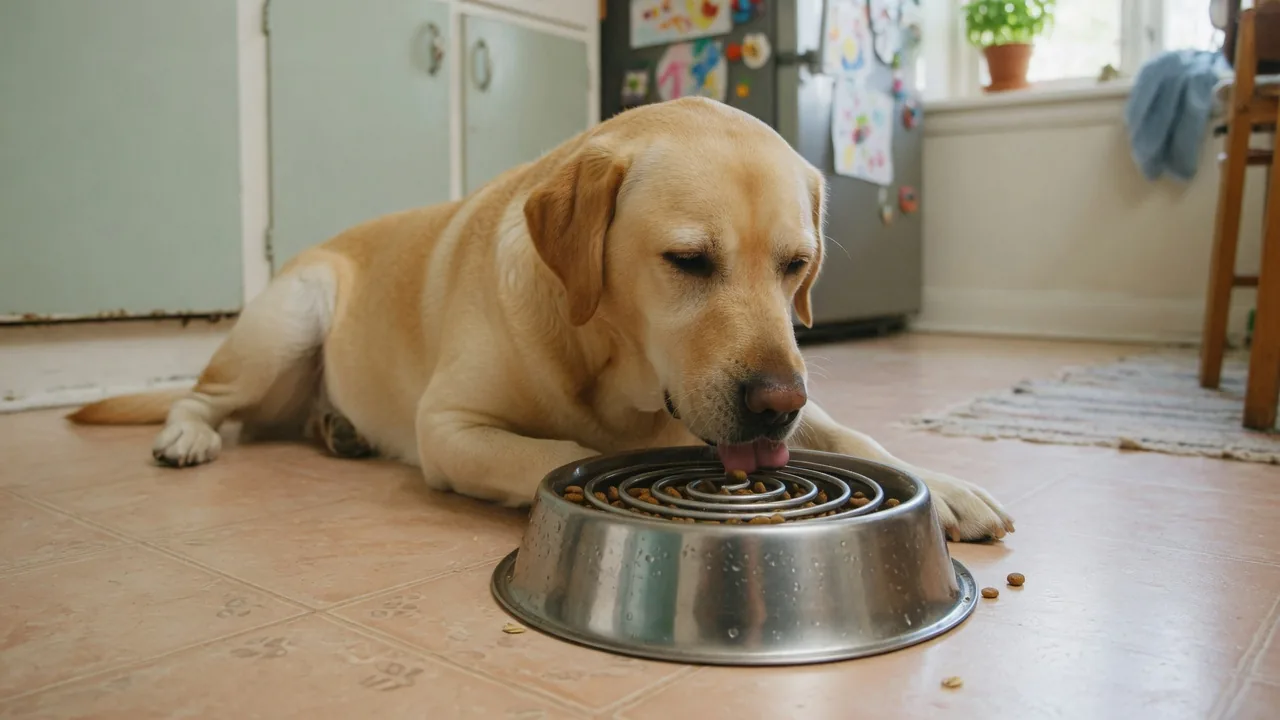
- Use a slow feeder bowl. This is the most reliable, hands-off fix. The built-in maze turns a 10-second gulp into a multi-minute meal, which can help reduce the overfull-stomach rebound. A stainless steel slow feeder does this at every meal and stays scratch-free and easy to sanitize, unlike plastic, which scratches over time.
- Split meals into smaller portions. Two or three smaller meals put less volume in the stomach at once than one big one.
- Feed dogs separately in multi-dog homes, so no one rushes to eat before food is "stolen."
- Add a dog-safe obstacle (like a large, clean ball) to a normal bowl as a quick DIY pacer.
- Keep things calm around mealtimes — an over-excited dog gulps harder.
We rank and explain all of these in our full guide on how to stop your dog eating too fast. For most owners, the slow feeder is where to start.
👉 See the Stainless Steel Slow Feeder Dog Bowl →
The bottom line
When a dog eats too fast and throws up, it's usually regurgitation caused by too much food and air arriving too quickly — and slowing the meal down often solves it. Learn to tell effortless regurgitation from active vomiting, watch for the red flags, and never ignore a swollen belly with unproductive retching. For everyday gulping, a slow feeder is the simplest reliable fix — but if the pattern is new, worsening, or comes with other symptoms, let your vet take a look first.
Frequently Asked Questions
Why does my dog throw up after eating too fast? Usually because they've swallowed a large volume of food and air faster than the stomach and esophagus can handle, so the body pushes it back up. This is often regurgitation — effortless, undigested food brought up within minutes of eating.
What's the difference between regurgitation and vomiting in dogs? Regurgitation is effortless and happens soon after eating, bringing up undigested, often tube-shaped food. Vomiting involves active heaving and retching, can happen any time, and often includes partly digested food or yellow bile. Fast-eating rebound is usually regurgitation.
When should I take my dog to the vet for throwing up? Contact your vet if the vomiting is repeated, comes with lethargy, diarrhea, weight loss, blood, or won't stop after you slow meals down. Seek emergency care immediately if your dog has a swollen, hard belly and is retching without bringing anything up — that can signal bloat (GDV).
Will a slow feeder stop my dog throwing up after meals? It often helps a lot, because slowing the meal reduces the sudden overfull stomach that causes fast-eating regurgitation. If your dog keeps bringing food up even with a slow feeder, see your vet to rule out an underlying cause.