Best Slow Feeder for Golden Retrievers
The best slow feeder for a Golden Retriever is a large-capacity, deep-maze bowl with a heavy, non-slip base — sized for a big mouth and an enthusiastic eater, not a shallow maze built for a small or flat-faced breed. Goldens are medium-large, food-motivated dogs, so a bowl that's too light or too shallow gets flattened in seconds.
If you own a Golden Retriever, you already know the drill: food goes in the bowl, and thirty seconds later it's gone. A slow feeder for golden retrievers is one of the simplest fixes for this, but not every maze bowl on the market actually fits a Golden's build. Get the size or depth wrong and your dog either flattens the maze in seconds or gets frustrated trying to reach the last few kibbles.
This guide covers why Goldens eat the way they do, what to look for in a slow feeder for this specific breed, and how to introduce one without stressing an eager eater.
Why Golden Retrievers gulp their food
Golden Retrievers were bred as retrievers first — food-motivated, high-energy dogs that historically worked hard and ate on a schedule. That combination of strong food drive, a large mouth, and an eager, people-pleasing temperament adds up to a breed that treats mealtime like a race. Add a houseful of kids, other pets, or just years of habit, and fast eating becomes the default.
Golden Retrievers are also a medium-large breed with a reasonably deep chest, which means the same air-gulping concerns that apply to other deep-chested dogs are worth taking seriously here too. Slowing down mealtime isn't just about neatness — it's about reducing how much air gets swallowed along with the food.
What makes a slow feeder actually work for a Golden
A slow feeder that's designed for a small terrier or a flat-faced breed often isn't right for a Golden Retriever. Here's what to check:
- A wide, sturdy bowl base. Goldens eat with enthusiasm — a light plastic bowl skates across the floor. Look for a heavier build with a non-slip base.
- A maze deep and complex enough to actually slow a big mouth. Shallow ridges barely register with a dog this size and this motivated. You want real channels, not decorative bumps.
- Enough total capacity for a full meal. Golden Retrievers eat more per meal than small breeds, so a maze bowl that only holds a fraction of their portion just means round two in a normal bowl.
- A material that holds up to daily enthusiasm. Goldens push, nudge, and sometimes chew at their bowl. Scratch-prone plastic wears out fast and can start to smell.
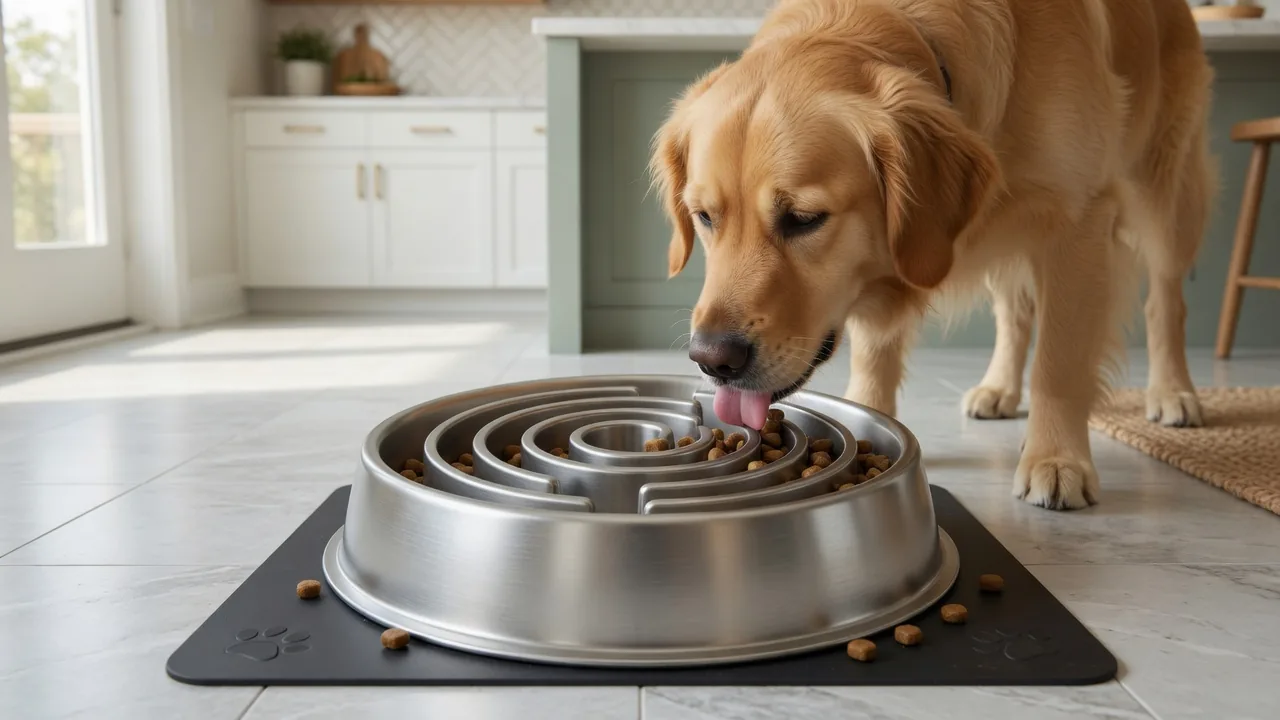
Our Stainless Steel Slow Feeder Dog Bowl checks all four boxes: a raised spiral maze deep enough to genuinely slow a determined eater, a heavy non-slip base that stays put through an enthusiastic meal, and dishwasher-safe stainless steel that won't scratch, warp, or hold odor the way plastic does over time.
Introducing a slow feeder to your Golden
Most Goldens take to a slow feeder without any fuss — food-motivated dogs are usually happy to work for their meal once they realize the food is still all there. A few tips to make the switch smooth:
- Use their normal portion. Don't reduce the amount of food, just change how it's presented.
- Let them problem-solve. Most Goldens figure out the maze within the first meal or two.
- Watch the pace, not just the finish time. The goal isn't a slow bowl for its own sake — it's a calmer, steadier meal with fewer gulped mouthfuls.
- Clean it after every meal. Stainless steel makes this a rinse-and-go job, which matters for a breed that eats twice a day, every day.
The bottom line
Golden Retrievers are exactly the kind of food-driven, deep-chested breed that benefits most from a well-designed slow feeder — but the bowl has to be sized and built for a dog this size and this enthusiastic. A shallow dollar-store maze won't cut it. A properly designed stainless steel feeder will.
If gulping, gas, or a too-fast dinner is a familiar scene at your house, this is a low-effort upgrade worth making today. For more background on how slow feeders help fast eaters generally, see our guide on why does my dog eat so fast.
👉 See the Stainless Steel Slow Feeder Dog Bowl →
❓ FAQ (also add FAQ schema)
What is the best slow feeder for a Golden Retriever? Look for a slow feeder with a deep, well-defined maze, a wide non-slip base, and enough capacity for a full meal. A stainless steel design also holds up better to a Golden's daily enthusiasm than scratch-prone plastic.
Do Golden Retrievers need a slow feeder? Not every Golden does, but many benefit from one. The breed's strong food drive and larger mouth size make fast, gulping meals common, and a slow feeder addresses that directly.
Can a slow feeder help with bloat risk in Golden Retrievers? Slowing eating can help reduce swallowed air, which is one contributing factor to bloat (GDV) in deep-chested breeds. A slow feeder is a sensible precaution, not a guaranteed prevention — talk to your vet about your dog's specific bloat risk.
How do I know if my Golden's slow feeder is the right difficulty? If your dog finishes almost as fast as with a regular bowl, the maze is too shallow. If they seem frustrated or give up, it may be too complex. A moderate, well-designed maze is the sweet spot for most Goldens.