Written by Ethan Walker · Reviewed against our Editorial Guidelines · Updated August 17, 2026
Slow Feeder Cat Bowls: Do Cats Need Them Too?
Yes — many cats gulp their food just as fast as dogs do, and a slow feeder cat bowl can genuinely help stop the messy, all-too-common "scarf and barf." Cats gulp for the same reasons dogs do — instinct, competition, and plain enthusiasm — and turning a 15-second inhale into a calmer few-minute meal often reduces the vomiting that comes with fast eating.
Here's how slow feeders work for cats, when they help, and how to introduce one without frustrating a fussy feline.
Do cats gulp their food?
Absolutely. Plenty of cats eat far too fast, especially in homes with more than one cat where meals feel like a competition. A cat that eats a whole bowl in seconds is swallowing air along with the food — and that often comes straight back up.
This is where the phrase "scarf and barf" comes from: the cat scarfs the meal, the full-and-fast stomach rejects it, and you're left cleaning up a pile of barely-digested food. It's messy, it wastes food, and it's uncomfortable for the cat. Slowing the meal down often reduces or stops it.
What is a slow feeder for cats?
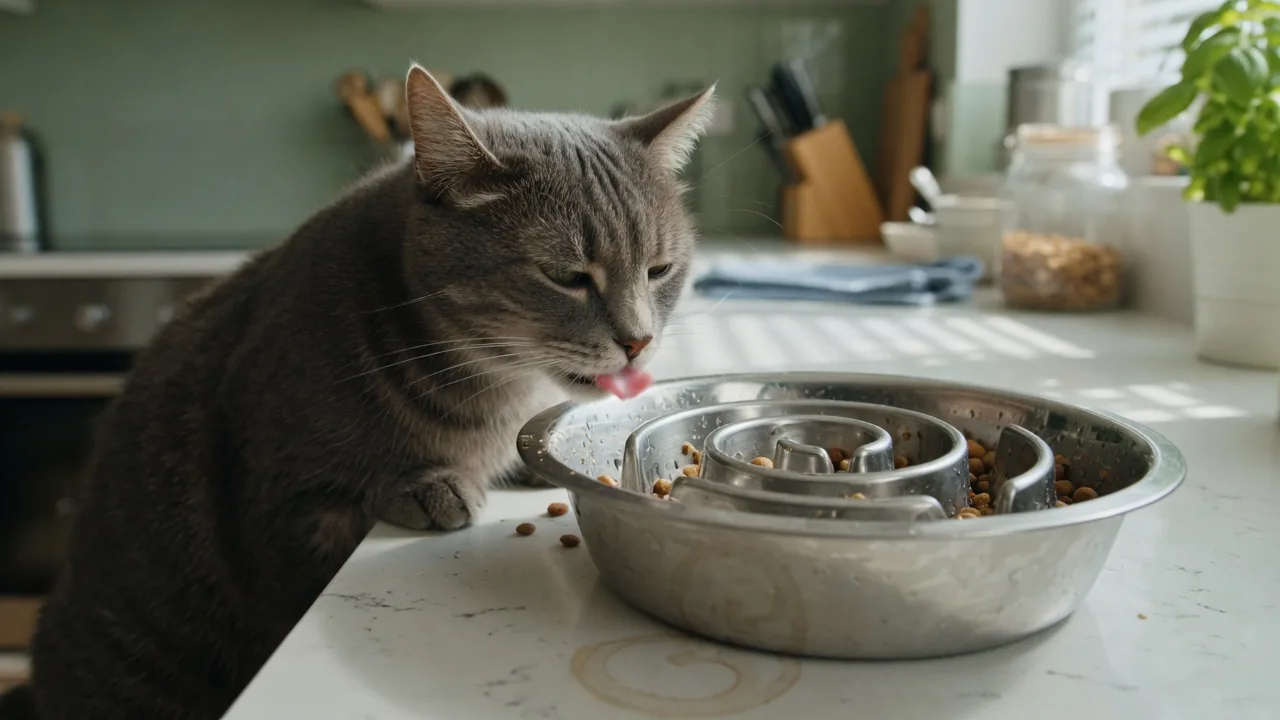
A slow feeder is a bowl with a built-in maze of ridges and channels. Instead of gulping from an open dish, your cat has to nudge and lick food out of the grooves — turning a 15-second inhale into a calmer few-minute meal. The same idea that works for gulping dogs works for gulping cats.
The benefits cat owners tend to notice:
- Less vomiting from eating too fast (the scarf-and-barf fix)
- Slower, calmer meals and less air swallowed
- A little mental enrichment — cats are natural hunters, and working for food taps into that
- Portion pacing for cats that beg the moment the bowl is empty
As always, if your cat vomits frequently, loses weight, or the problem is new, that's a vet conversation — persistent vomiting isn't something a bowl alone should be expected to fix.
What to look for in a slow feeder for cats
Cats are pickier than dogs about where they put their faces, so a few things matter:
- Shallow enough channels — cats dislike deep bowls that press on their whiskers. Lower-profile mazes suit them better.
- Non-slip base — a light cat can push a bowl around the floor while foraging.
- Non-porous, easy-clean material — this is the big one. Cat food (especially wet) leaves oily residue, and cats are sensitive to smell and hygiene.
- The right maze difficulty — start easy so your cat doesn't give up.
On material specifically, stainless steel is the most hygienic choice. It's non-porous, so it doesn't trap residue or odors in scratches the way plastic does, and it's dishwasher-safe. Some cats are also prone to feline chin acne linked to grubby plastic bowls, so a smooth steel surface that actually gets clean is a sensible pick.
An honest note on our bowl
Full transparency: our stainless steel slow feeder is designed and marketed as a dog bowl, and it comes in dog-appropriate sizes. That said, the material and maze principle are exactly what you'd want in a slow feeder for a cat — non-porous steel, dishwasher-safe, easy to keep hygienic.
For a smaller cat, a dog slow feeder can be too large or the maze too deep, so it isn't a perfect one-to-one swap. If you have a larger cat, or a multi-pet household where dogs and cats share the concept, the steel bowl can absolutely work. For a petite cat, look for the shallowest maze you can find and introduce it gradually. We'd rather tell you that up front than pretend it's a purpose-built cat product.
👉 See the Stainless Steel Slow Feeder →
For the full rundown of maze designs, materials, and sizing across the whole category, our best slow feeder dog bowls guide covers the principles that apply to cats too.
How to introduce a slow feeder to your cat
Cats can be suspicious of change, so ease them in:
- Start easy. For the first few meals, place food on top of the maze and only loosely in the channels so your cat wins quickly.
- Use their normal food so the only new thing is the bowl.
- Keep it in the usual spot. Cats are territorial about feeding stations — don't move the location and the bowl at the same time.
- Be patient. If your cat walks off, go easier on the difficulty and try again. Never let a fussy cat skip meals for long — cats that stop eating can get sick quickly, so check with your vet if they refuse food.
- Clean it after every meal, especially with wet food.
Frequently Asked Questions
Do cats need a slow feeder? Not every cat, but many benefit. If your cat gulps meals and then vomits ("scarf and barf"), eats frantically, or competes with other pets, a slow feeder can pace them and reduce vomiting from fast eating.
Do slow feeders help cats stop throwing up? Often, yes — when the vomiting is caused by eating too fast. Slowing the meal means less gulped air and less regurgitation. If your cat vomits frequently or it's a new problem, see your vet, as it can have other causes.
Can a cat use a dog slow feeder? It can work, especially for larger cats or multi-pet homes, since the steel and maze principle is the same. For a small cat, a dog bowl may be too big or the maze too deep, so choose the shallowest option and introduce it slowly.
What's the best material for a cat slow feeder? Stainless steel is the most hygienic — non-porous, dishwasher-safe, and it won't trap residue or odors like scratched plastic. It's also a smart pick for cats prone to chin acne from grubby bowls.