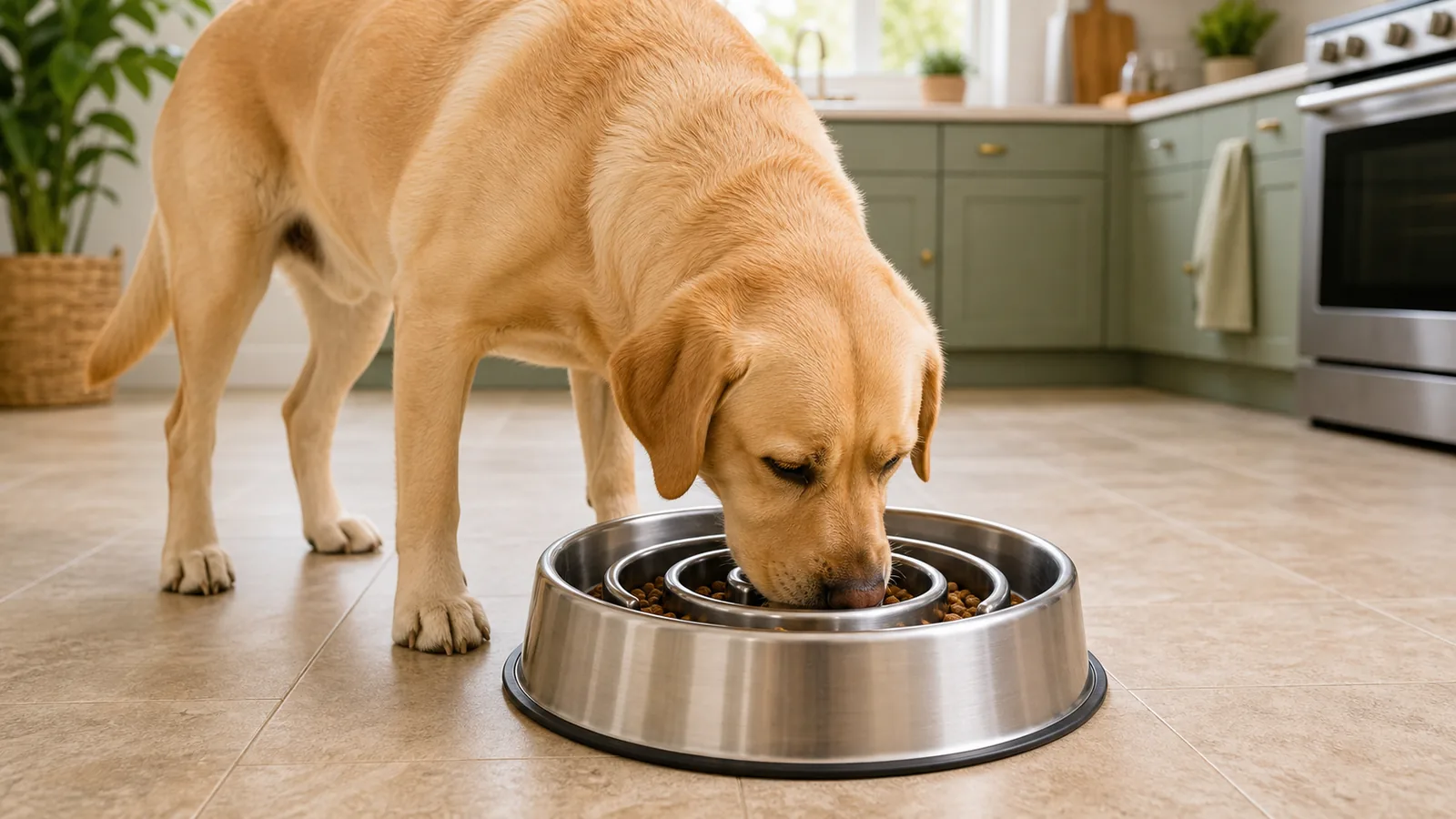
Best Slow Feeder for Large Dogs (Great Danes, German Shepherds & More)
The best slow feeder for large dogs is a large-capacity, deep-mazed stainless steel bowl with enough weight and a non-slip base to stay put under a powerful eater — not a toy-breed feeder. If you own a big dog, you already know the problem: a large breed can empty a standard bowl in seconds, gulping air along with every mouthful. A slow feeder for large dogs fixes that — but it has to be sized and built for a powerful eater, not a toy breed. The wrong feeder is too small, too shallow, or too light to stay put under a determined Great Dane or German Shepherd.
This matters more for large dogs than most, because many big breeds are deep-chested — a body shape linked to a higher risk of bloat (GDV). Slowing the meal is one simple, at-home step that may help reduce how much air your dog swallows. Here's how to choose the right feeder.
Why large and deep-chested breeds benefit most
Deep-chested breeds — Great Danes, German Shepherds, Standard Poodles, Boxers, Weimaraners, Setters and Doberman Pinschers, among others — have a body shape that is associated with a higher risk of GDV (gastric dilatation-volvulus), commonly called bloat. It's a life-threatening emergency where the stomach fills with gas and can twist.
No bowl can prevent bloat, and the causes aren't fully understood. But eating too fast and swallowing air is one factor researchers point to, and slowing a fast eater is one of the few easy things owners can control. A slow feeder may contribute to reducing swallowed air — it's a sensible precaution for a big, fast-eating dog, not a cure. If your breed is on the deep-chested list, it's worth talking to your vet about bloat risk and prevention overall.
What to look for in a slow feeder for large dogs
1. Genuinely large capacity
Big dogs eat big meals. A feeder that's too small either won't hold the portion or spreads it so thin there's no real slowing effect. Choose a feeder rated for large breeds that comfortably fits your dog's full meal.
2. A deep, challenging maze
Large dogs have big tongues and strong snouts — they'll clear a shallow, easy maze almost as fast as an open bowl. A deeper, more challenging maze pattern is what actually slows a powerful eater down.
3. Enough weight and a non-slip base
A big dog will shove a light bowl across the room. Look for a feeder with real weight and a non-slip base so it stays put while your dog works the food out. Stainless steel naturally carries more heft than thin plastic.
4. Tough, chew-resistant material
Powerful jaws make short work of soft plastic, which can crack into swallowable pieces — a choking and blockage risk. A stainless steel slow feeder can't be chewed apart, won't crack, and shrugs off daily use from a strong dog.
5. Hygiene that lasts
A big dog eats a lot, every day. Plastic scratches and traps bacteria over time; stainless steel is non-porous and dishwasher-safe, so it actually stays clean meal after meal.
Our pick for large dogs
For most large and deep-chested breeds, the stainless steel slow feeder dog bowl ticks every box: it has the weight to stay put, a maze that paces strong eaters, and steel construction that a powerful dog can't chew apart or crack. It's dishwasher-safe and rust-proof, so it holds up to the volume a big dog goes through. Choose the larger size to match a big-breed portion.
👉 See the Stainless Steel Slow Feeder Dog Bowl →
For more on why steel beats plastic for a heavy-duty eater, see our stainless steel vs plastic slow feeder comparison.
How to slow a large dog at mealtime
- Use the largest appropriate maze. Big dogs need a deeper challenge than small dogs.
- Keep the full portion in one feeder rather than topping up — refilling lets your dog rush the second helping.
- Feed in a calm, low-competition spot. In multi-dog homes, separate big eaters so no one feels they have to race.
- Avoid heavy exercise right around meals. For deep-chested breeds, many vets suggest not exercising hard immediately before or after eating — ask yours about timing.
- Watch your dog after meals and learn the warning signs of bloat (below).
Know the warning signs of bloat
Because large, deep-chested dogs are at higher risk, every owner should know the signs of GDV (bloat) — it's a true emergency. Contact your vet or an emergency clinic immediately if you see:
- A swollen, hard, or distended belly
- Unproductive retching (trying to vomit but nothing comes up)
- Restlessness, pacing, or obvious distress
- Drooling, panting, or a hunched posture
Bloat can progress fast and is life-threatening — when in doubt, treat it as an emergency and call your vet. A slow feeder is a helpful precaution, but it is not a treatment, and it does not replace urgent veterinary care.
The bottom line
The best slow feeder for large dogs is big enough for a full meal, deep enough to challenge a strong eater, heavy enough to stay put, and tough enough to survive powerful jaws — which is exactly where stainless steel shines. For deep-chested breeds especially, slowing meals is a simple precaution that may help reduce swallowed air, though it's never a guarantee against bloat. Pair it with knowing the warning signs and a chat with your vet.
👉 Built for big eaters — Stainless Steel Slow Feeder Dog Bowl →
❓ FAQ (also add FAQ schema)
What is the best slow feeder for large dogs? The best one is sized for a big portion, has a deep, challenging maze, enough weight and a non-slip base to stay put, and is made of a chew-proof material. A stainless steel slow feeder fits all of these and won't crack or get chewed apart by a strong dog.
Do slow feeders help prevent bloat in deep-chested breeds? They may help reduce how much air a dog swallows while eating, which is one factor linked to bloat — but no bowl can prevent GDV. Slowing meals is a sensible precaution, not a cure. Talk to your vet about bloat risk for your breed.
Are stainless steel slow feeders better for big dogs? Generally yes. Stainless steel has the weight to resist a big dog pushing it around, can't be chewed into pieces, won't crack, and stays hygienic with daily heavy use — all advantages over plastic for a large breed.
What size slow feeder does a Great Dane or German Shepherd need? Choose a large-breed size that comfortably holds your dog's full meal in one feeder. Splitting a big portion into a too-small bowl reduces the slowing effect, so size up for big breeds.