Written by Ethan Walker · Reviewed against our Editorial Guidelines · Updated August 17, 2026
Best Slow Feeder for Dachshunds
The best slow feeder for a Dachshund is a shallow-to-moderate maze bowl scaled for a small, narrow snout, paired with a wide, stable, non-slip base. Most slow feeder bowls are built with deep channels sized for medium and large dogs, so a Dachshund's nose can't reach the food; too shallow a maze, and it barely slows them down at all.
Dachshunds have a lot of personality packed into a small, low-slung body — and a small, narrow snout that most slow feeder bowls simply weren't designed for. A slow feeder for dachshund dogs needs to get the scale right, or it just doesn't work: too deep a maze and their nose can't reach the food, too shallow and it barely slows them down at all.
This guide covers why sizing matters so much for this breed, how feeding posture connects to their long back, and what to look for in a bowl that actually fits.
Why Dachshund size and snout shape matter for slow feeders
Most slow feeder bowls on the market are designed with a "one size fits most" maze — deep channels and tall ridges meant for medium and large dogs. That's a poor match for a Dachshund's small, narrow snout. A maze that's too deep or too tight can make it physically hard for a Dachshund to reach the food at all, leading to frustration or a dog that just gives up and waits by the empty-looking bowl.
At the same time, a Dachshund's food drive is nothing to underestimate — this is a breed known for being determined and a little stubborn, so a maze that's too shallow won't slow them down any more than a regular bowl would. The right slow feeder for a Dachshund needs a maze scaled to a small, narrow snout: shallow enough to reach easily, but still complex enough to genuinely break up big mouthfuls.
Feeding posture and a Dachshund's long back
Dachshunds are a breed prone to back problems, most notably intervertebral disc disease (IVDD), because of their long spine and short legs. While a slow feeder bowl itself doesn't treat or prevent back issues, feeding posture is worth thinking about for this breed:
- Avoid excessive stretching or twisting to reach food, which can happen if a bowl is placed somewhere awkward or too far from where your dog naturally stands.
- A stable, low, non-slip bowl means your Dachshund isn't pushing or chasing a sliding bowl across the floor, which can put unnecessary strain on their back and neck.
- Some owners use a slightly raised feeding station for dogs with existing back sensitivity — but this is genuinely dog-specific advice, and you should check with your vet before changing feeding height, especially if your Dachshund has a history of back problems.
None of this replaces a vet's guidance if your Dachshund has diagnosed IVDD or another back condition — feeding posture is a minor consideration alongside the bigger factors your vet will already be managing.
What to look for in a slow feeder for a Dachshund
- A shallow-to-moderate maze scaled for a small, narrow snout — not a bowl designed for a Labrador.
- A wide, stable, non-slip base so the bowl doesn't slide as your Dachshund works the maze.
- A low profile that doesn't force an awkward reach or stretch.
- Durable, easy-to-clean material that holds up to daily use without scratching or trapping odor.
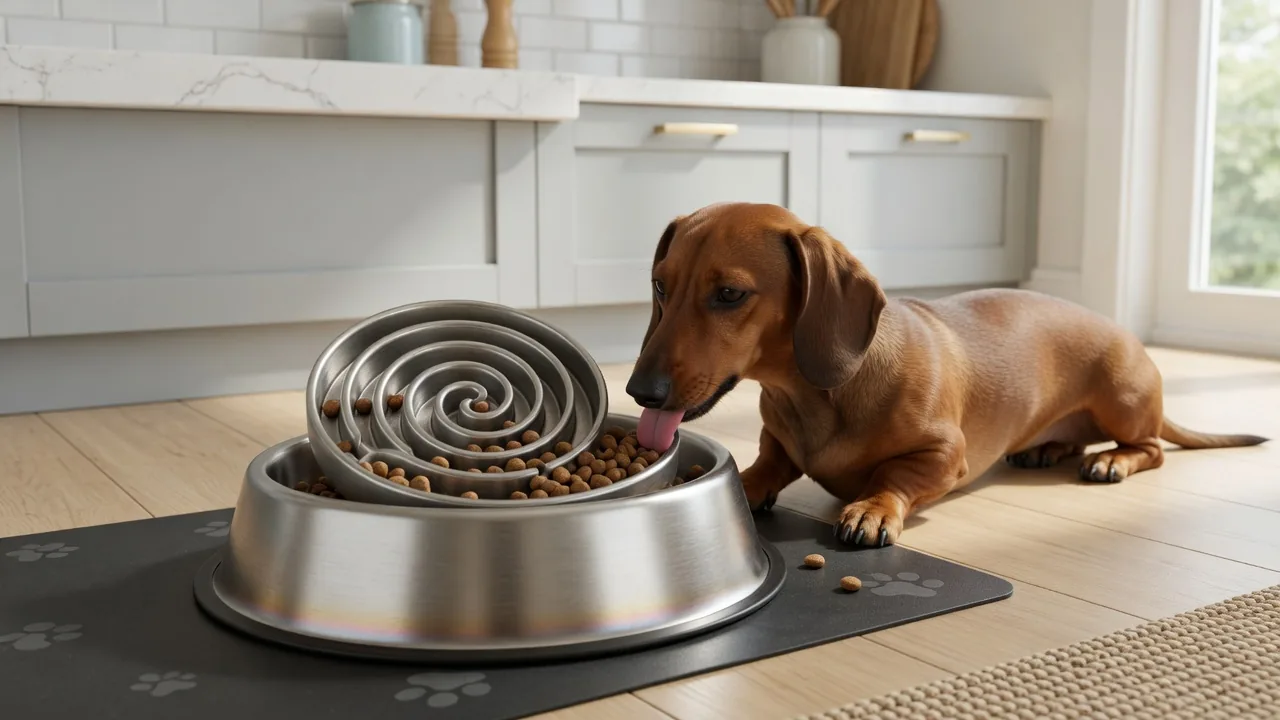
Our Stainless Steel Slow Feeder Dog Bowl has a raised spiral maze designed to genuinely slow gulping while staying accessible, plus a non-slip base that keeps the bowl steady during meals — no awkward chasing or stretching required. Dishwasher-safe stainless steel also means one less scratched, smelly surface to worry about.
Introducing a slow feeder to your Dachshund
- Keep the same portion size — the bowl changes the pace, not the amount.
- Watch how easily they reach the food in the first meal or two, and adjust if the maze seems too deep for comfortable reach.
- Place the bowl somewhere stable and easy to approach, avoiding tight corners or slippery flooring that could encourage awkward stretching.
- Clean after every meal to keep the bowl appealing and hygienic.
The bottom line
For Dachshunds, getting the slow feeder's scale right matters just as much as the maze itself. A bowl built for a bigger dog's snout will frustrate a Dachshund or fail to slow them down at all. Look for a well-designed, appropriately scaled maze with a stable, low, non-slip base — and if your Dachshund has any back sensitivity, loop your vet in on feeding posture too.
For more on why slower eating matters across breeds, see our guide on best slow feeders for puppies, which covers similar small-scale sizing considerations.
👉 See the Stainless Steel Slow Feeder Dog Bowl →
Frequently Asked Questions
Do Dachshunds need a special slow feeder? Not a special product, but sizing matters more than usual. Dachshunds have a small, narrow snout, so a slow feeder maze needs to be shallow enough to reach comfortably while still slowing down gulping.
Can a slow feeder bowl help with a Dachshund's back problems? A slow feeder doesn't treat or prevent back conditions like IVDD, but a stable, low, non-slip bowl can reduce awkward stretching or sliding during meals. Always follow your vet's specific guidance if your Dachshund has diagnosed back issues.
What maze depth is best for a Dachshund? A shallow-to-moderate maze scaled for a small, narrow snout works best. Too deep and your Dachshund may struggle to reach the food; too shallow and it won't meaningfully slow them down.
Are Dachshunds fast eaters? Many are — Dachshunds can be determined, food-motivated dogs despite their small size, which is exactly why a well-sized slow feeder is worth considering.